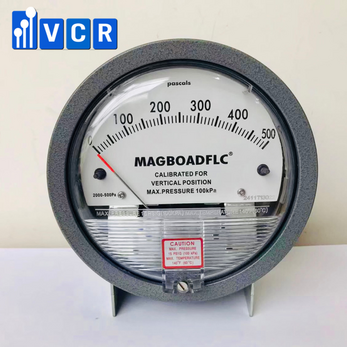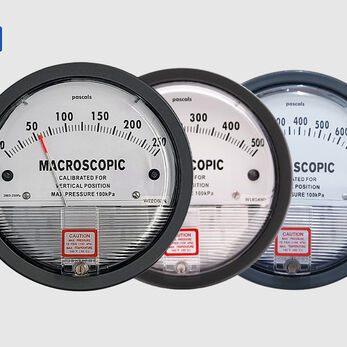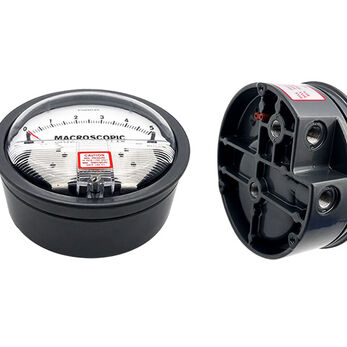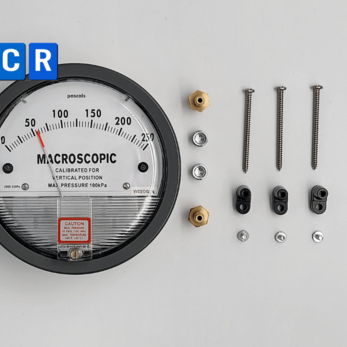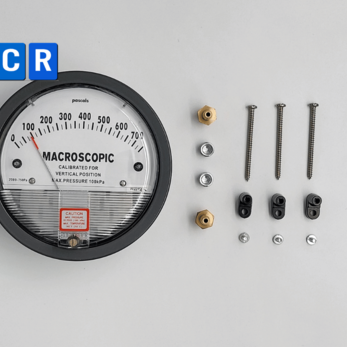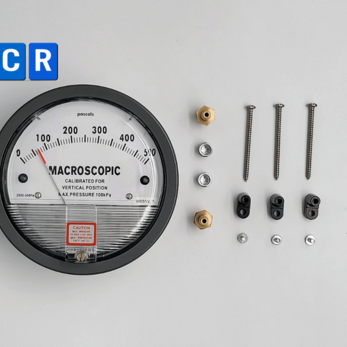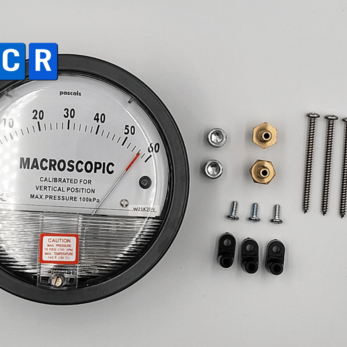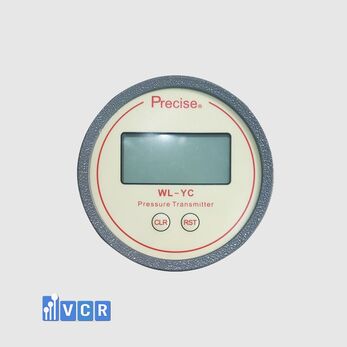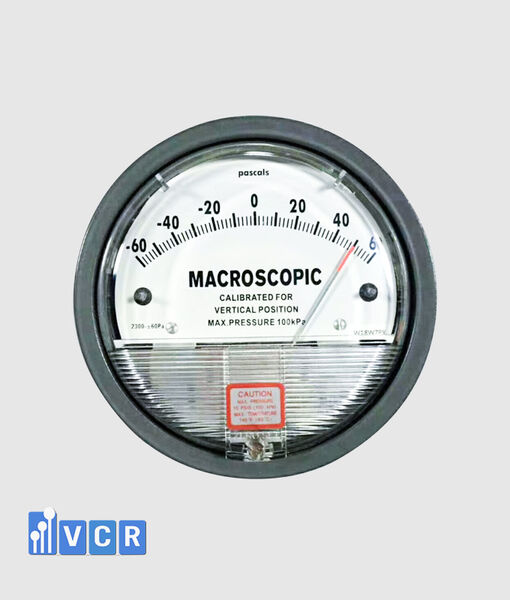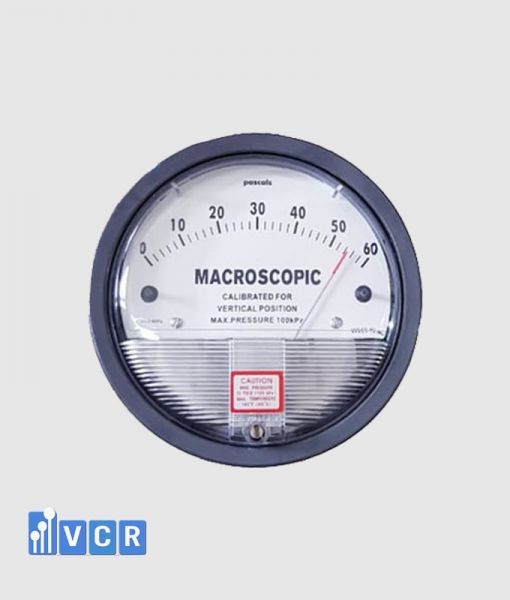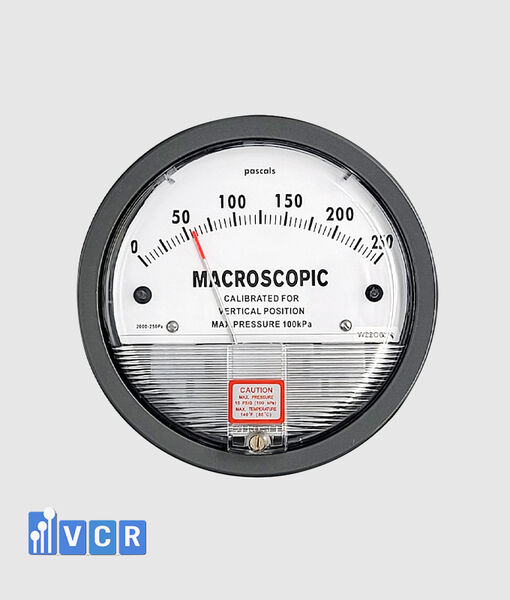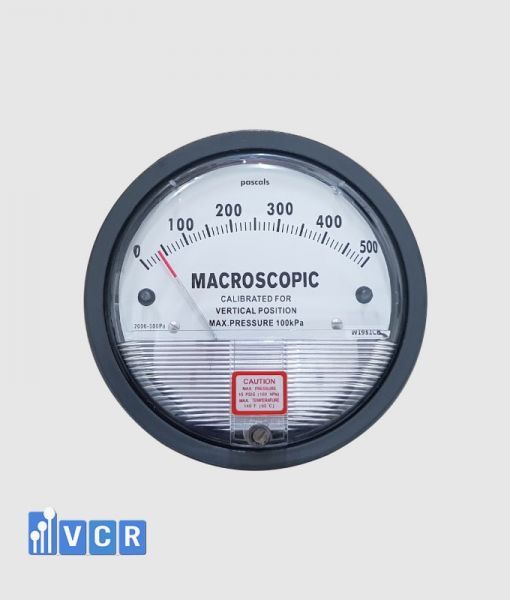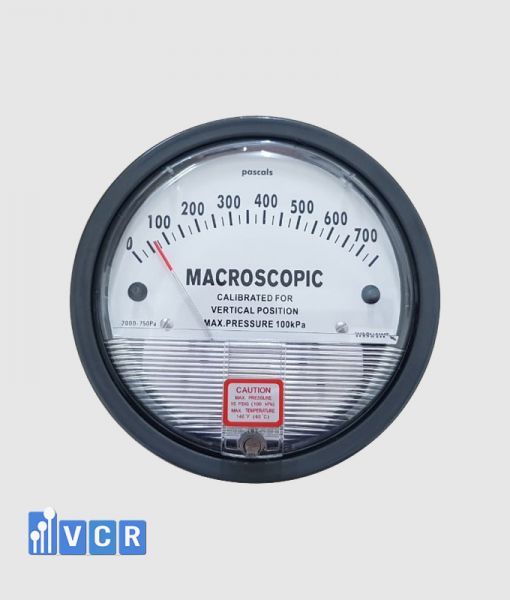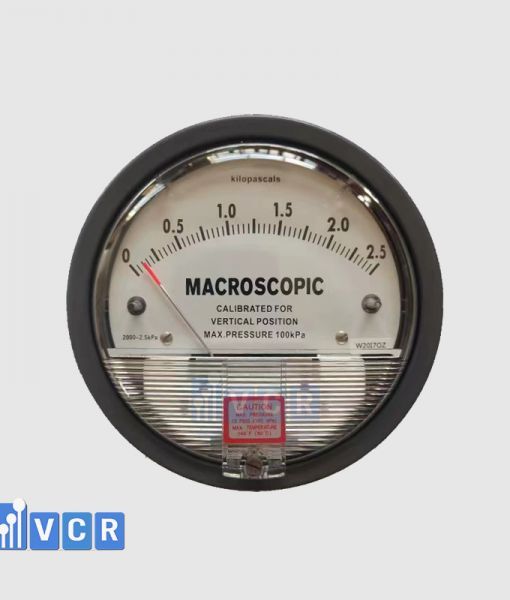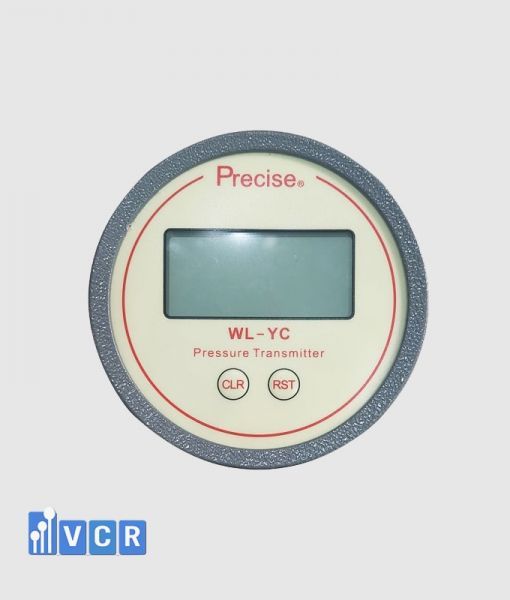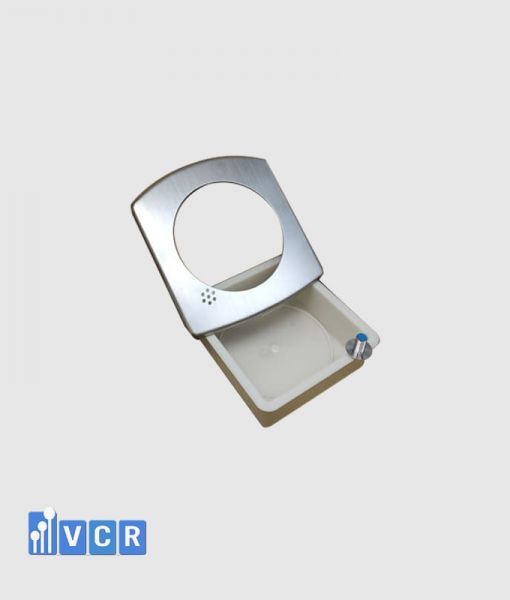

A differential pressure gauge measures the pressure difference between two points. It is widely used for cleanroom pressure, HEPA filter loading, AHUs and HVAC equipment, and may be mechanical, digital, alarm-equipped or connected to PLC, BMS and EMS systems.
- What is a differential pressure gauge?
- What is differential pressure?
- Operating principle
- Classification by display type
- Classification by function
- Classification by measuring range
- Classification by application
- Cleanroom pressure monitoring
- HEPA filter monitoring
- AHU and HVAC applications
- LAF and dispensing booth applications
- Hospital and laboratory applications
- How to select a differential pressure gauge
- Installation requirements
- Calibration and periodic inspection
- Common mistakes
- Frequently asked questions
- Conclusion
What is a differential pressure gauge?
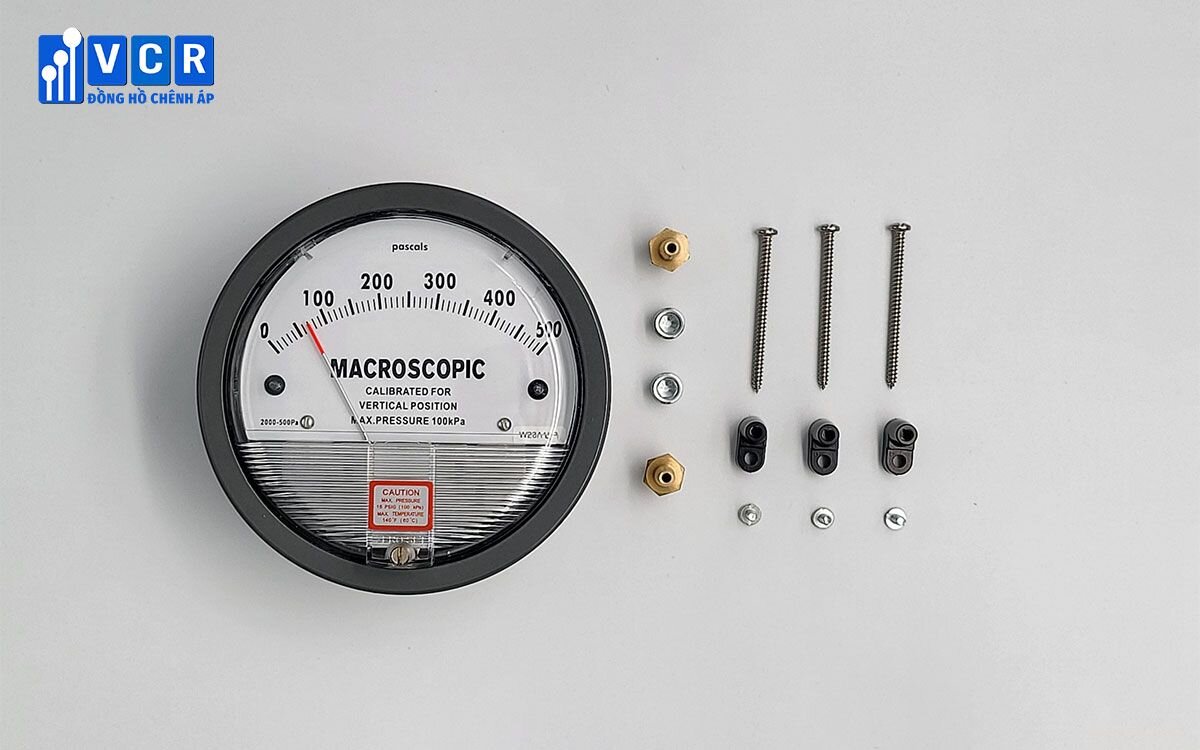
A differential pressure gauge measures the difference in pressure between two locations in the same system.
The instrument receives pressure through two separate connections and calculates the difference between them. The result is displayed by a mechanical pointer or an electronic screen.
Depending on the application, the gauge may compare pressure between two rooms, between a cleanroom and a corridor, across a filter or between two points in an air duct.
Differential pressure gauges are widely used in cleanrooms, HVAC systems, AHUs, HEPA boxes, FFUs, pass boxes, air showers, laminar airflow units, dispensing booths, hospitals and laboratories.
What is differential pressure?
Differential pressure is the difference between two pressure values.
The basic equation is:
Differential pressure = High-port pressure − Low-port pressure
The High port, normally marked “+”, connects to the higher-pressure point. The Low port, marked “−”, connects to the lower-pressure point.
For positive cleanroom pressure, the High port may connect to the cleanroom and the Low port to the corridor.
For HEPA filter monitoring, the High port is connected upstream and the Low port downstream.
Common units include Pa, kPa, mmH₂O, mbar and in.w.c.
Operating principle
The general principle is to convert pressure difference into mechanical movement or an electrical signal.
A mechanical gauge uses a diaphragm, capsule or magnetic mechanism. When differential pressure changes, the sensing element moves and drives the pointer.
An electronic gauge uses a pressure sensor. The sensor converts differential pressure into an electrical signal, which is processed and displayed numerically.
Some electronic instruments also provide 4–20 mA, 0–10 V, RS485 or Modbus outputs for PLC, HMI, BMS or EMS integration.
Measurement reliability depends not only on the instrument but also on the pressure tapping location, tubing condition, measuring range and system operating conditions.
Classification by display type
Mechanical pointer gauge
A mechanical gauge has a graduated dial and pointer.
It is common in cleanrooms and HVAC systems because it is simple, visible and normally requires no external power.
It is suitable where operators only need local indication and do not require automatic alarms or data logging.
Its limitations include manual reading, possible parallax error and reduced readability when the range is too wide.
Electronic differential pressure gauge
An electronic gauge displays the value on an LCD or LED screen.
It often provides better display resolution and may include alarms, relays or output signals.
This type is suitable for continuous monitoring and central control systems.
It requires electrical power and may lose display and output functions during a power interruption.
Classification by function
Local indication only
This type only measures and displays the value. Mechanical gauges normally belong to this group.
It is suitable for measurement points that are inspected according to an operating or maintenance schedule.
Gauge with alarm contacts
Some gauges include electrical contacts or relays.
When pressure crosses the configured limit, the contact changes state and can activate a light, buzzer or control-panel input.
This provides threshold status but may not provide a continuous proportional measurement signal.
Gauge or sensor with 4–20 mA output
A 4–20 mA transmitter converts pressure into a proportional current signal.
Four milliamps normally represents the low end of the range, while 20 milliamps represents the high end.
This output is widely used for PLC, HMI, BMS and EMS monitoring.
Device with 0–10 V output
The 0–10 V signal is also common in HVAC and building automation.
It is easy to interface with many controllers but may be more sensitive to electrical interference and voltage drop over long cable distances.
RS485 or Modbus device
Digital communication allows the instrument to transmit pressure, alarm status, units and diagnostic information.
Modbus is useful for projects with many sensors because several devices can share one network.
Correct address, baud rate, wiring and termination are required.
Classification by measuring range
Low ranges such as 0–30 Pa, 0–60 Pa, 0–100 Pa and 0–125 Pa are commonly used for cleanroom and isolation-room pressure.
Ranges such as 0–250 Pa, 0–500 Pa, 0–750 Pa and 0–1,000 Pa are commonly used for filter and HVAC applications.
Higher ranges may be required for ducts, fans and components with greater pressure loss.
Bidirectional ranges such as −30 to +30 Pa or −60 to +60 Pa are suitable where pressure may be either positive or negative.
The range should be selected from expected operating values, maximum conditions and required resolution.
Classification by application
Cleanroom differential pressure gauge
This gauge monitors the pressure relationship between two spaces.
It helps operators determine whether the HVAC system is maintaining the intended airflow direction.
An abnormal value may indicate an open door, panel leakage, supply-return imbalance, fan problems or damper movement.
Filter differential pressure gauge
A filter gauge measures the pressure drop between the upstream and downstream sides of a filter.
As dust accumulates, pressure drop normally increases when airflow remains comparable.
This device may also be called a filter-loading indicator, filter clogging gauge or dirty-filter gauge.
AHU differential pressure gauge
In an AHU, separate gauges may be installed across pre-filters, bag filters, fine filters and HEPA filters.
Individual monitoring helps maintenance personnel identify which filter stage is becoming loaded.
Cleanroom-equipment gauge
Differential pressure gauges are also installed on pass boxes, air showers, FFUs, laminar airflow units, HEPA boxes, clean booths and dispensing booths.
The measurement may represent filter resistance, plenum pressure or room-to-booth pressure.
Cleanroom pressure monitoring
Differential pressure supports airflow-direction control between clean areas.
A positive-pressure room is maintained above adjacent areas to reduce inward contamination.
A negative-pressure room is maintained below surrounding areas to contain dust or hazardous materials.
A local gauge allows operators to observe this condition directly.
Critical rooms may use electronic sensors connected to a BMS or EMS for alarms and historical records.
The required pressure difference should be based on the approved design and risk assessment rather than a universal value.
HEPA filter monitoring
Differential pressure gauges are widely used to monitor HEPA filter resistance.
The High port is connected upstream and the Low port downstream.
The clean-filter reading should be recorded at an approved airflow as the baseline.
A rising differential pressure under comparable airflow conditions may indicate increasing dust loading.
However, differential pressure does not confirm HEPA filter integrity. A damaged or poorly sealed filter must be identified through an appropriate HEPA leak test.
A low reading does not necessarily indicate a clean filter. Reduced airflow, weak fan performance, leaking tubing or bypass leakage may also reduce the value.
AHU and HVAC applications
In AHUs, differential pressure gauges monitor filter loading and pressure loss across selected components.
A pressure sensor may also confirm fan operation or maintain duct static pressure.
When connected to a variable-frequency drive, the signal may be used to adjust fan speed.
The control system should include limits, delay and sensor-fault alarms.
Fan control should not continuously compensate for a blocked filter without generating a maintenance warning.
LAF and dispensing booth applications
In laminar airflow units and dispensing booths, differential pressure may be used to monitor filters, plenum pressure or room pressure.
Filter-pressure monitoring helps identify increasing resistance.
Room-pressure monitoring helps confirm the intended airflow relationship between the booth and adjacent areas.
Electronic sensors can generate high-filter-pressure, low-room-pressure and signal-failure alarms.
Differential pressure should be evaluated together with airflow velocity, airflow visualisation, filter integrity and containment performance.
Hospital and laboratory applications
Differential pressure gauges are used in isolation rooms, operating rooms, laboratories and microbiology areas.
Isolation rooms may require negative pressure to contain airborne contaminants.
Operating rooms and sterile areas may require positive pressure to reduce contamination entering from adjacent spaces.
Critical applications often combine local indication with remote alarms.
How to select a differential pressure gauge
First determine whether the instrument will measure room pressure, filter resistance or duct pressure.
Then identify the normal operating value, expected maximum, unit and required resolution.
A mechanical gauge is suitable for local indication. An electronic device is more appropriate when alarms, data logging or control-system integration are required.
The selected range should exceed the maximum expected value without being unnecessarily wide.
Accuracy, full-scale error, zero adjustment, enclosure protection, mounting orientation, accessories and calibration documentation should also be reviewed.
Installation requirements
The High port connects to the higher-pressure point and the Low port to the lower-pressure point.
Pressure taps should represent static pressure and should not be installed directly in high-velocity or turbulent airflow.
Tubing must be airtight, free from kinks and protected from condensation.
High and Low tubes should be clearly identified.
Mechanical gauges should be mounted in the manufacturer’s specified orientation and checked for zero before pressure is applied.
Electronic devices require verification of the power supply, output signal, scaling and HMI value.
Calibration and periodic inspection
Differential pressure gauges should be calibrated according to measurement criticality and the facility’s quality programme.
Calibration is not the same as adjusting the pointer to zero. The device should be compared with a reference pressure source at several points.
Electronic devices should also be checked for 4–20 mA output, relay operation, alarm function and PLC/HMI indication.
Pressure tubing and tapping points should be inspected periodically.
An abnormal reading should be investigated together with airflow, fan condition, doors, dampers and tubing before the gauge is declared defective.
Common mistakes
One common mistake is using one measuring range for every application.
Room pressure and filter pressure drop normally require very different ranges.
Another mistake is reversing the High and Low ports.
Some users assume that an increasing filter pressure always means the filter has failed. In reality, the value is also affected by airflow and fan speed.
Electronic displays are sometimes assumed to be automatically more accurate than mechanical gauges. Actual accuracy depends on the model, range, installation and calibration.
Ignoring the pressure tubing is another frequent source of incorrect readings.
Frequently asked questions
Is a differential pressure gauge the same as a DP gauge?
Yes. Both terms refer to an instrument that measures the difference between two pressure points.
Does it require electrical power?
Mechanical gauges normally do not. Electronic gauges and transmitters normally require power.
Can a room-pressure gauge monitor a HEPA filter?
Only when the measuring range is appropriate. Many room-pressure gauges have ranges that are too low for filter monitoring.
Can differential pressure detect a HEPA leak?
No. It measures pressure loss only. Filter integrity requires a leak test.
Should a mechanical or electronic type be selected?
Mechanical gauges are suitable for local indication. Electronic devices are preferred for alarms, data logging and PLC, BMS or EMS integration.
Why does the gauge not return to zero?
Possible causes include trapped pressure, incorrect mounting orientation, zero drift or calibration error.
Conclusion
A differential pressure gauge measures the pressure difference between two points.
It may be classified by display type, output signal, measuring range and application.
Mechanical gauges are practical for local monitoring. Electronic gauges and transmitters are suitable for alarm, data transmission and automatic-control applications.
In practice, differential pressure gauges are used for cleanroom pressure, HEPA filter loading, AHU filter stages, FFUs, pass boxes, air showers, laminar airflow units and dispensing booths.
Correct range selection, High–Low connection, pressure tapping and calibration determine measurement reliability.
VCR Cleanroom Equipment supplies mechanical differential pressure gauges, electronic indicators and transmitters with 4–20 mA, 0–10 V and Modbus outputs. VCR also supports range selection, accessories, calibration, installation and commissioning for cleanrooms, AHUs, HEPA boxes, pass boxes, air showers, FFUs, laminar airflow units and dispensing booths.