
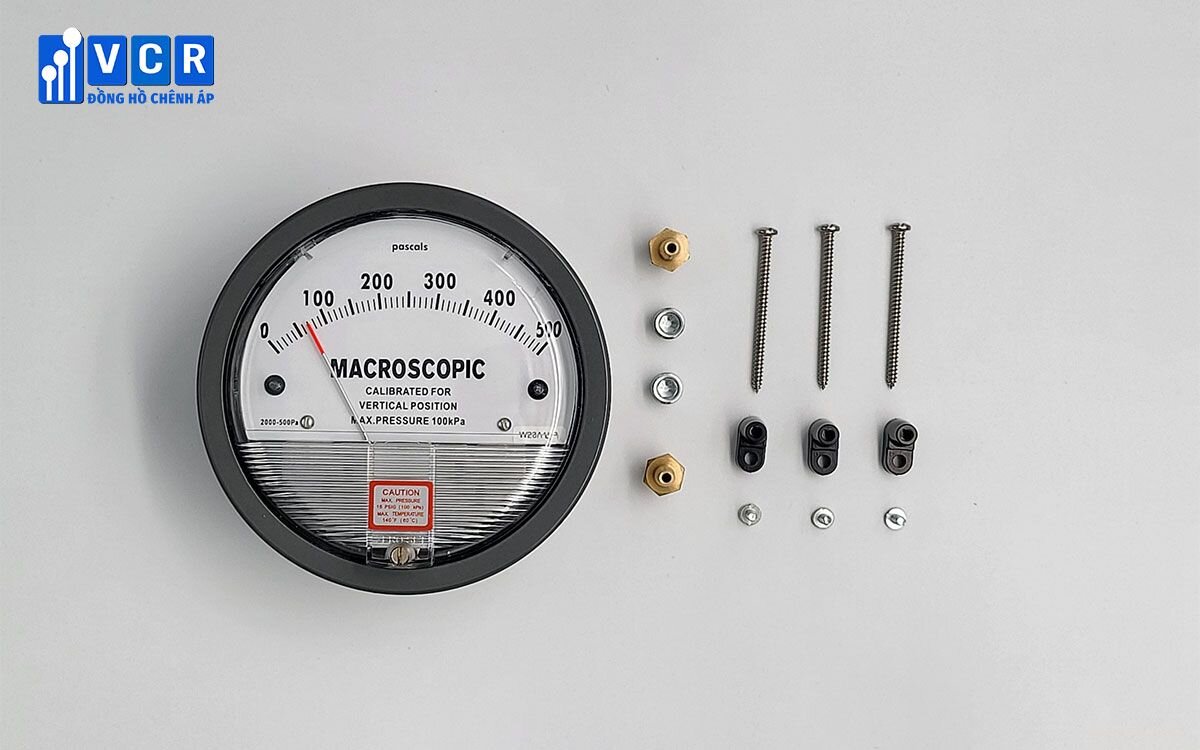
Selecting a cleanroom differential pressure gauge requires careful review of range, accuracy, calibration, accessories and local technical support. Macroscopic is a practical option due to its broad range selection, frictionless magnetic mechanism and competitive investment cost.
- Which brand should be selected?
- Why are differential pressure gauges required in cleanrooms?
- Why does the brand matter?
- What is Macroscopic?
- Main advantages of Macroscopic gauges
- Suitable applications
- Is Macroscopic suitable for GMP cleanrooms?
- Limitations to consider
- Macroscopic versus premium brands
- How to select the correct Macroscopic model
- What should a quotation include?
- Where can Macroscopic gauges be purchased?
- Frequently asked questions
- Is Macroscopic intended for cleanroom use?
- Does a Macroscopic pointer gauge require electricity?
- Should a 0–60 Pa or 0–125 Pa model be selected?
- Can a 0–750 Pa model be used for room pressure?
- Can Macroscopic be used in GMP facilities?
- What is the price of a Macroscopic gauge?
- Does Macroscopic provide 4–20 mA output?
- Conclusion
Which brand should be selected?
No single differential pressure gauge brand is suitable for every cleanroom measurement point. A suitable instrument must match the measuring purpose, pressure range, resolution, calibration requirement and local support needs.
When a project requires a mechanical pointer gauge with multiple pressure ranges, simple operation, no external power and a reasonable investment cost, Macroscopic is a practical brand to consider.
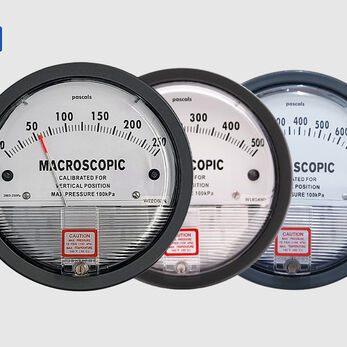
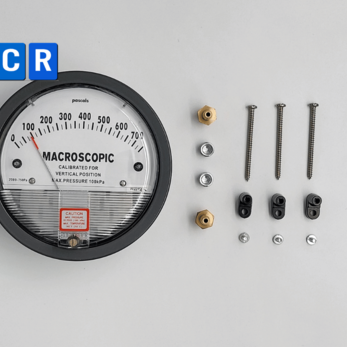
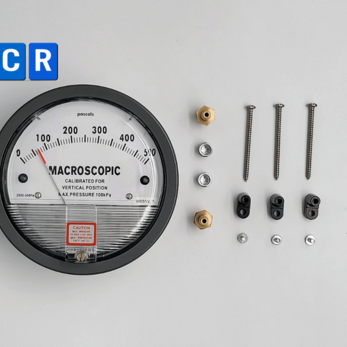
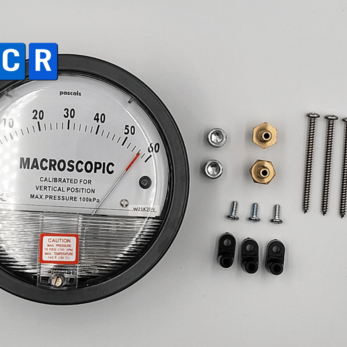
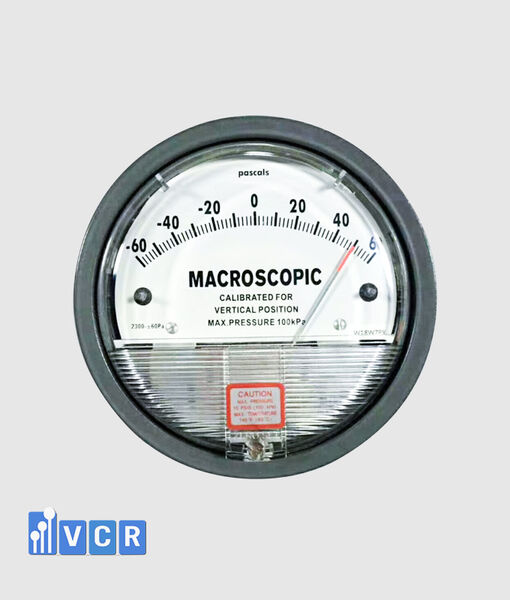
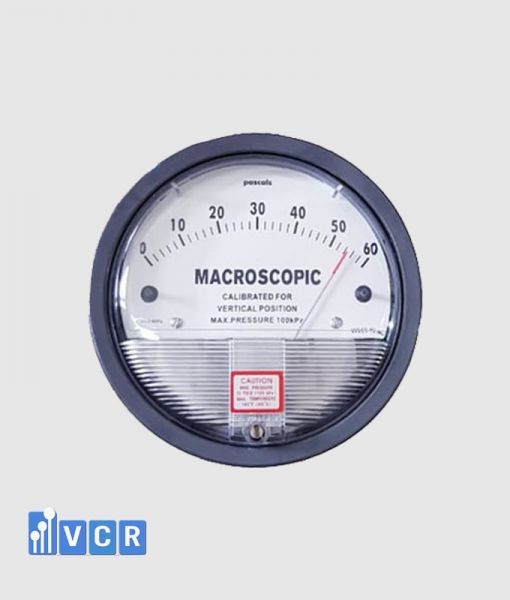
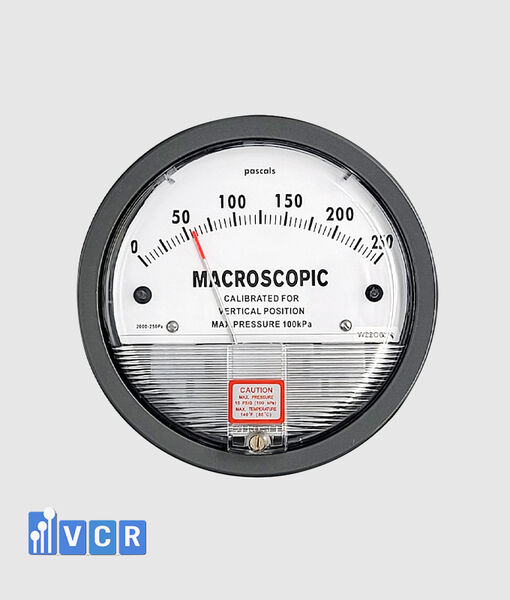
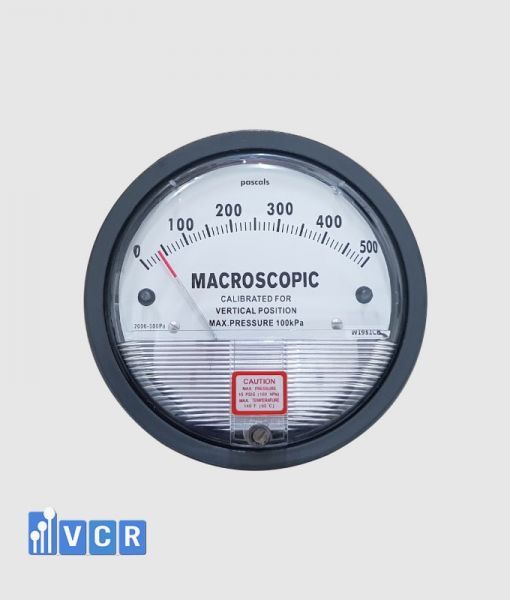
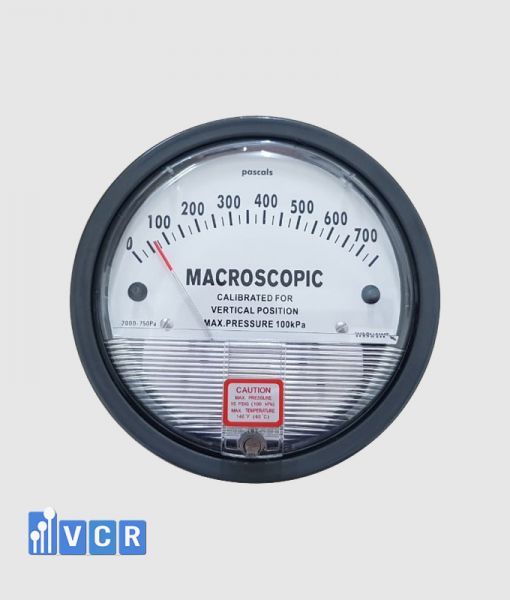
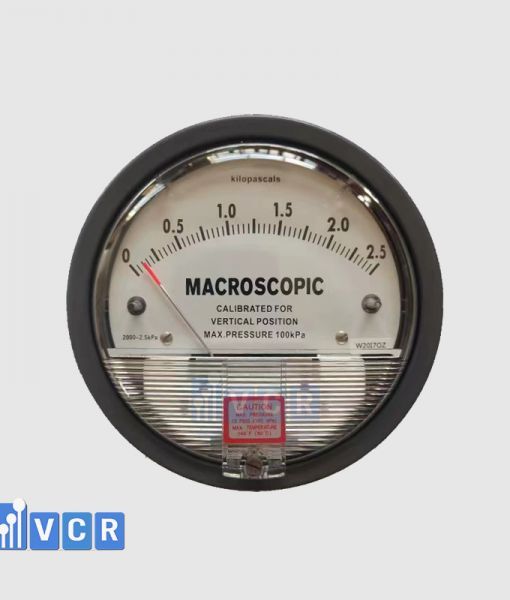
Macroscopic gauges supplied by VCR are available in ranges such as −60 to +60 Pa, 0–60 Pa, 0–125 Pa, 0–250 Pa, 0–500 Pa and 0–750 Pa. These options cover applications from room-pressure indication to HEPA filter, AHU, FFU and clean-air-equipment monitoring.
The instrument should not be selected only by brand name or selling price. Correct range selection, High–Low connection, pressure tapping and calibration remain essential.
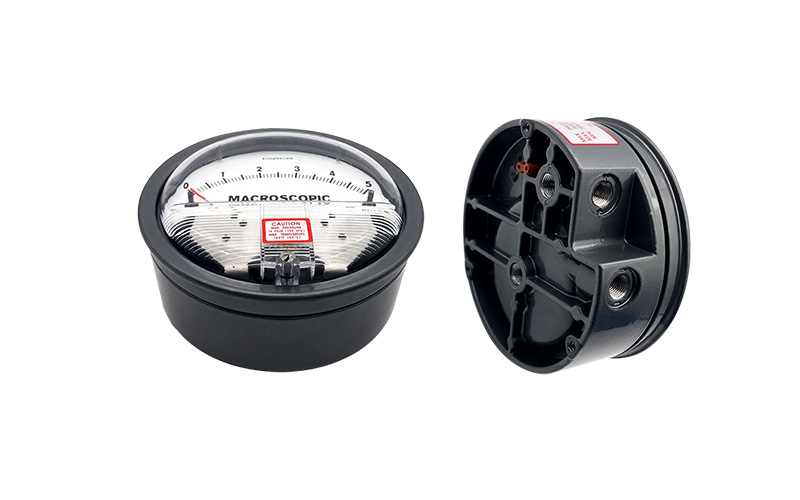
Why are differential pressure gauges required in cleanrooms?
A differential pressure gauge measures the pressure difference between two locations.
In cleanrooms, it is commonly installed between a production room and a corridor, between areas with different cleanliness grades or between a cleanroom and an airlock.
The indication helps operators determine whether the HVAC system is maintaining the intended pressure cascade and airflow direction. An abnormal value may indicate an open or poorly sealed door, fan-performance change, damper movement, room leakage or an imbalance between supply and return airflow.
The instrument can also measure pressure drop across a filter. As dust loading increases resistance, differential pressure generally rises when airflow remains comparable.
Differential pressure gauges may be installed on AHUs, HEPA boxes, FFUs, dynamic pass boxes, air showers, clean booths, laminar airflow units and dispensing booths.
Why does the brand matter?
Cleanroom differential pressure is often measured at very low pressure levels. Room-pressure applications may involve only a few tens of pascals.
The stability of the measuring mechanism, zero return and dial readability therefore affect practical monitoring.
A product without clear range, connection, accuracy or installation information may create difficulties during commissioning, maintenance and calibration.
Brand selection also influences the availability of accessories, technical documents, CO, CQ, calibration support and replacement products.
However, a premium international brand is not automatically the best option when the project requires only reliable local indication. Delivery time, range availability, budget and technical support in Vietnam should also be evaluated.
What is Macroscopic?
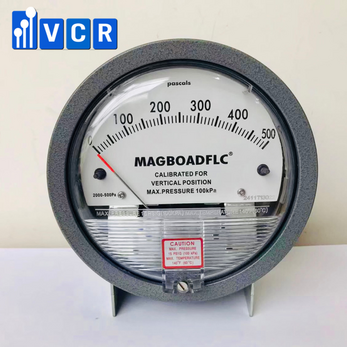
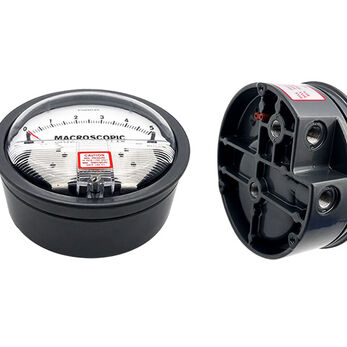
Macroscopic is a mechanical differential pressure gauge range intended for air and compatible non-corrosive gases. It may be applied to positive, negative and differential pressure measurements.
According to VCR’s published product information, Macroscopic gauges use frictionless magnetic components, reducing direct mechanical contact and wear within the indication mechanism.
The product range includes low-pressure scales for room monitoring and wider scales for filters and HVAC equipment. This helps designers select different gauges for different measurement duties rather than applying one model throughout the facility.
Macroscopic should not be positioned only as a low-cost product. Its main value is providing straightforward local differential-pressure indication with simple installation and no dependence on electrical power.
Main advantages of Macroscopic gauges
Multiple measuring ranges
The range portfolio is one of Macroscopic’s practical advantages.
A 0–60 Pa gauge can be considered for low room-pressure applications. A 0–125 Pa gauge provides more capacity for airlocks, clean corridors and spaces where operating pressure fluctuates more widely.
The 0–250 Pa, 0–500 Pa and 0–750 Pa ranges are better suited to HEPA filters, HEPA boxes, AHUs and FFUs, depending on actual clean and final filter resistance.
The final selection must be based on design data rather than equipment name alone.
No external power for indication
A mechanical pointer gauge does not normally require an electrical supply for its basic indication function.
This simplifies installation because no power wiring, communication configuration or PLC input is required.
Macroscopic is therefore suitable where local observation is sufficient and continuous records or automatic alarms are unnecessary.
Frictionless magnetic mechanism
VCR’s product information describes Macroscopic as using frictionless magnetic components. This design supports pointer response without a conventional contacting transmission arrangement.
The gauge must still be correctly mounted, zero-checked and calibrated according to project requirements. A frictionless mechanism does not mean that the device can never drift or requires no inspection.
Clear local display
A pointer dial allows operators to quickly recognise whether pressure is rising, falling or approaching an operating limit.
For filter monitoring, the pointer position can be compared with the clean-filter baseline. For room monitoring, personnel can check pressure locally without opening an HMI screen.
Competitive project cost
Public VCR pricing articles place several Macroscopic ranges at approximately VND 1.2–1.39 million per unit. The actual price may vary according to quantity, VAT, accessories, CO/CQ, calibration and delivery conditions.
This cost level is attractive for projects requiring many local measuring points without power supplies, analogue input modules or programming.
Suitable applications
Room-pressure monitoring
Macroscopic can be installed between cleanrooms, corridors, airlocks, changing rooms and support areas.
Low ranges such as 0–60 Pa and 0–125 Pa are normally more suitable for room-pressure applications. A bidirectional range may be selected when both positive and negative conditions must be observed.
The range should match the design pressure and alarm limits. A wider range should not be selected merely because it appears more versatile.
HEPA filters and HEPA boxes
For filter monitoring, the High port is connected upstream and the Low port downstream.
Ranges such as 0–250 Pa, 0–500 Pa or 0–750 Pa may be considered according to the initial and final filter pressure drop.
A 0–750 Pa model is more appropriate for higher filter resistance and is normally too wide for low room-pressure measurement.
A differential pressure gauge does not confirm HEPA integrity or filtration efficiency. It only indicates pressure loss and filter loading conditions.
AHU filter stages
A separate gauge should be considered for each filter stage when operators need to identify which filter is becoming loaded.
Macroscopic may be applied to pre-filters, bag filters, fine filters and HEPA filters when the correct scale is selected.
One gauge measuring the total resistance of several stages cannot identify the individual filter causing the increase.
FFUs, pass boxes and air showers
FFUs, dynamic pass boxes and air showers often contain HEPA filters. A Macroscopic gauge can provide direct local indication of filter pressure drop or equipment pressure conditions.
Where only local inspection is needed, the mechanical gauge is a straightforward solution.
Where automatic alarms or PLC signals are required, the project should add a differential pressure switch or electronic transmitter.
Is Macroscopic suitable for GMP cleanrooms?
Macroscopic may be used in a GMP cleanroom when the selected model, measuring range, installation, calibration and documentation meet project requirements.
GMP suitability is not determined by the brand name alone. It also depends on the measurement purpose, acceptance criteria, SOPs, calibration programme and response to out-of-limit conditions.
For local indication, a Macroscopic mechanical gauge may be appropriate.
For critical points requiring alarms, historical records or continuous monitoring, an electronic sensor should be added or used alongside the local gauge.
A practical arrangement is to use Macroscopic for local visual indication and a 4–20 mA transmitter for PLC or BMS monitoring at critical points.
Limitations to consider
A standard Macroscopic pointer gauge is primarily a local indicator. It does not automatically log data, communicate with a PLC or generate remote alarms without additional equipment.
The reading may be affected by viewing angle. The pointer can fluctuate if pressure tapping points are positioned near fans, diffusers or turbulent airflow.
Measurement also depends on the condition of the tubing. Leaks, kinks, disconnection or condensation can cause incorrect indication.
These are general limitations of mechanical differential pressure gauges rather than issues unique to Macroscopic.
Macroscopic versus premium brands
Premium international brands may provide longer brand histories, specialised certification, more electronic configurations or extensive global documentation.
They may also have higher purchasing costs and longer delivery periods.
When the project only requires clear local indication, purchasing more functions than necessary may not provide proportional value.
Macroscopic is particularly suitable when the project prioritises:
-
Straightforward pointer indication.
-
Multiple ranges for rooms and filters.
-
Competitive cost.
-
Convenient local supply.
-
Available accessories.
-
Technical support in Vietnam.
The selection should focus on technical suitability and lifecycle cost rather than brand reputation alone.
How to select the correct Macroscopic model
First determine whether the instrument will measure room pressure or filter pressure drop.
For room pressure, provide the design differential pressure, pressure direction and required limits.
For filter monitoring, provide the initial resistance, recommended final resistance, airflow and filter type.
The full-scale range should exceed the maximum expected value but should not be unnecessarily wide.
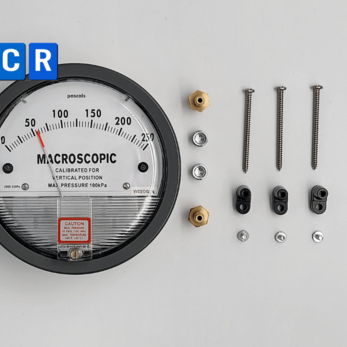
The buyer should also verify the Pa unit, pointer condition, zero adjustment, High–Low ports and supplied accessories. These checks are also reflected in VCR’s Macroscopic selection guidance.
What should a quotation include?
A complete quotation should identify the brand, model, range, unit, quantity, origin, accessories and warranty.
CO, CQ and calibration requirements should be stated clearly. The buyer should not assume that the listed instrument price includes calibration.
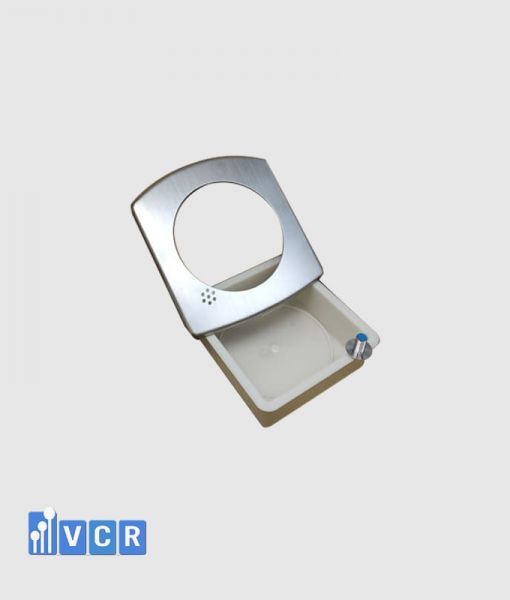
A complete installation may also require pressure tubing, tapping points, fittings, a mounting box and fixing accessories.
For projects with multiple gauges, a measuring-point schedule should be prepared. Each point should identify its location, purpose and required range.
Where can Macroscopic gauges be purchased?
VCR Cleanroom Equipment supplies Macroscopic differential pressure gauges for cleanrooms, HEPA filters, AHUs, HEPA boxes, FFUs, pass boxes, air showers and HVAC systems. VCR also provides accessories and application-based selection support.
Purchasing from a supplier with cleanroom experience provides more value than receiving the instrument alone.
The supplier should be able to review measuring range, High–Low connections, pressure tapping, calibration and documentation requirements.
For an accurate quotation, the customer should provide installation locations, quantities, expected ranges, CO/CQ requirements, calibration scope, VAT and requested delivery date.
Frequently asked questions
Is Macroscopic intended for cleanroom use?
Yes. It includes low ranges for room-pressure indication and wider ranges for HEPA filters, AHUs, HEPA boxes and FFUs.
Does a Macroscopic pointer gauge require electricity?
No external power is normally required for the basic pointer indication.
Should a 0–60 Pa or 0–125 Pa model be selected?
A 0–60 Pa model is more sensitive for lower pressure differences. A 0–125 Pa model is more suitable where the design pressure or operating variation is higher.
Can a 0–750 Pa model be used for room pressure?
It is normally too wide for low room-pressure applications. It is better suited to HEPA filters, AHUs, FFUs and other higher-resistance applications.
Can Macroscopic be used in GMP facilities?
Yes, when the selected range, accuracy, installation, calibration and documentation meet the facility’s requirements.
What is the price of a Macroscopic gauge?
Public VCR references place several ranges at approximately VND 1.2–1.39 million per unit, subject to quantity, accessories, VAT, documentation and calibration.
Does Macroscopic provide 4–20 mA output?
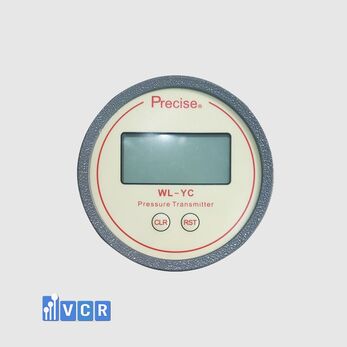
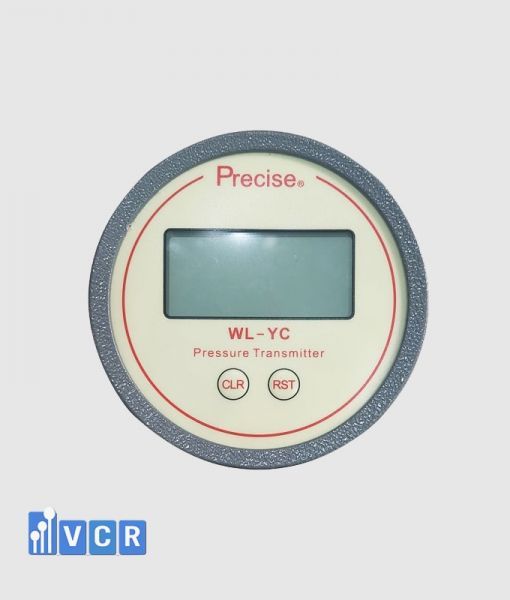
Standard pointer models focus on local indication. Projects requiring 4–20 mA, alarms or data logging should add an electronic differential pressure sensor or select a suitable electronic instrument.
Conclusion
A cleanroom differential pressure gauge should not be selected only by brand name or price. The correct product must match the measuring range, display requirement, accessories and project documentation.
Macroscopic is a practical option for applications requiring a simple, visible and cost-effective mechanical gauge without an electrical supply.
Its multiple measuring ranges allow the brand to support both room-pressure indication and filter-pressure-drop monitoring.
Macroscopic can be applied to cleanrooms, airlocks, AHUs, HEPA boxes, FFUs, pass boxes, air showers and HVAC equipment, provided that each measurement point is reviewed separately.
Customers can contact VCR Cleanroom Equipment for Macroscopic range selection, accessories, calibration and project documentation. Application-based selection provides a more reliable result than using one common model throughout the complete cleanroom system.