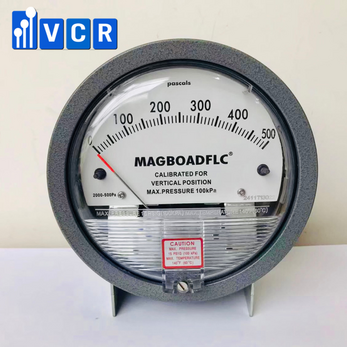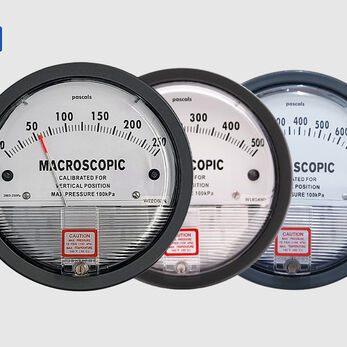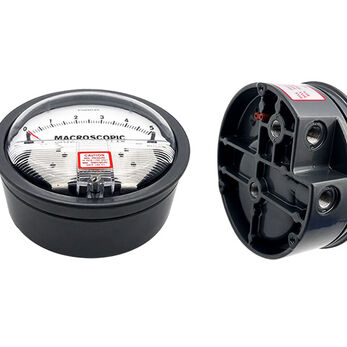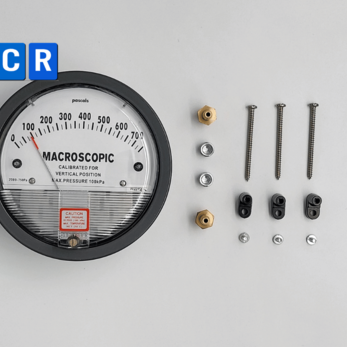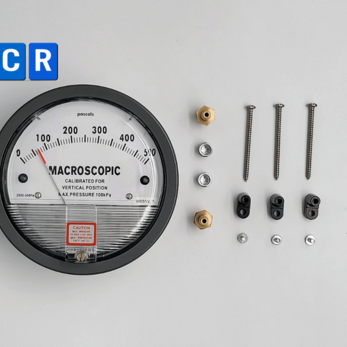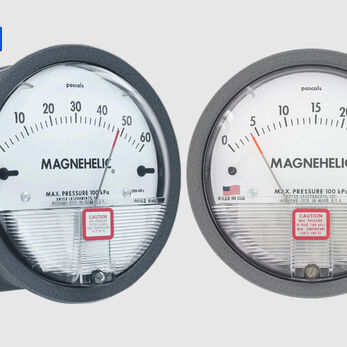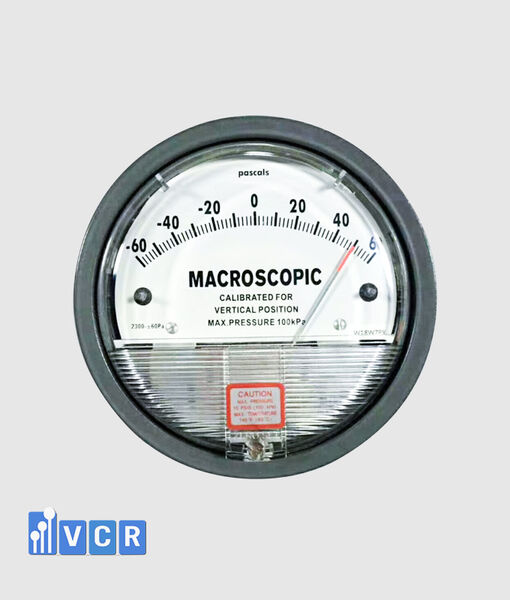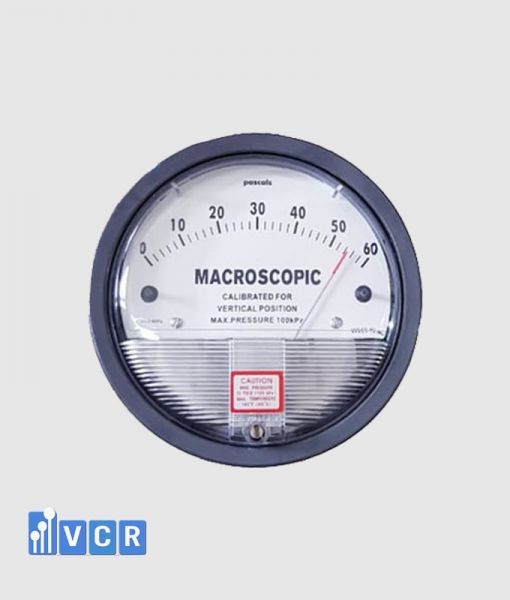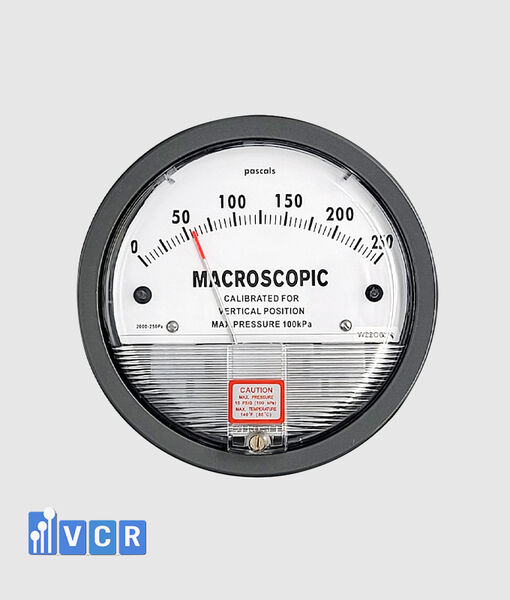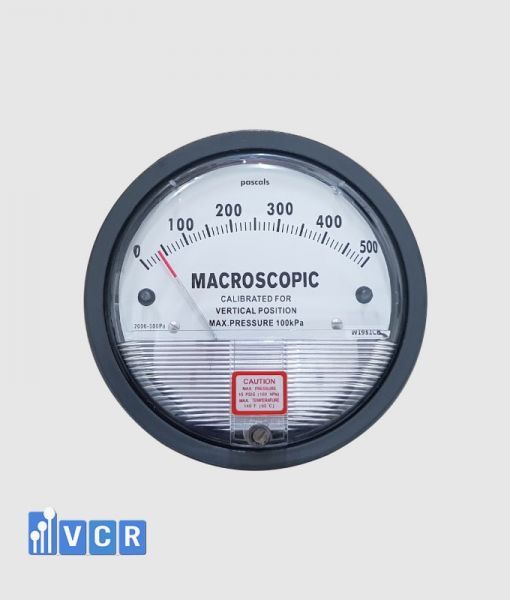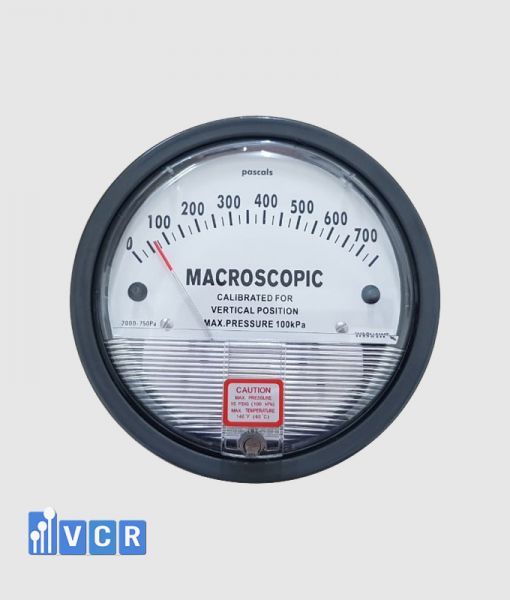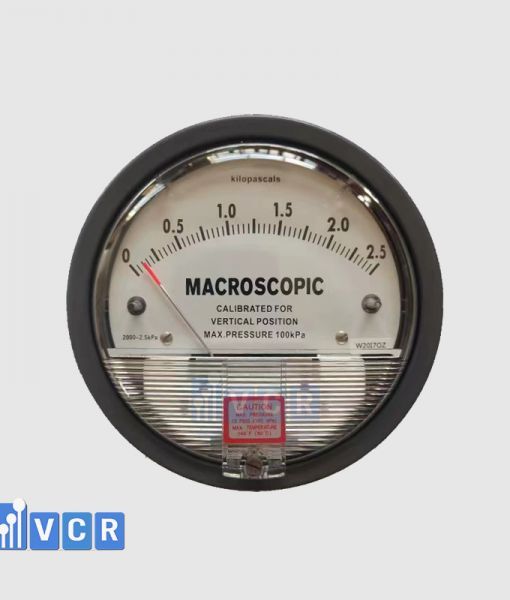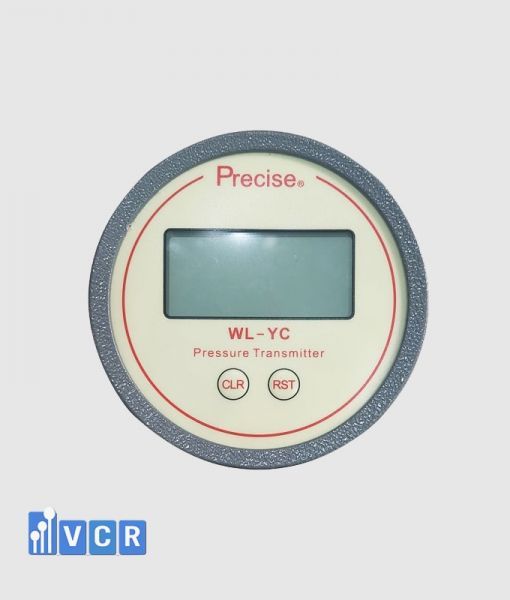

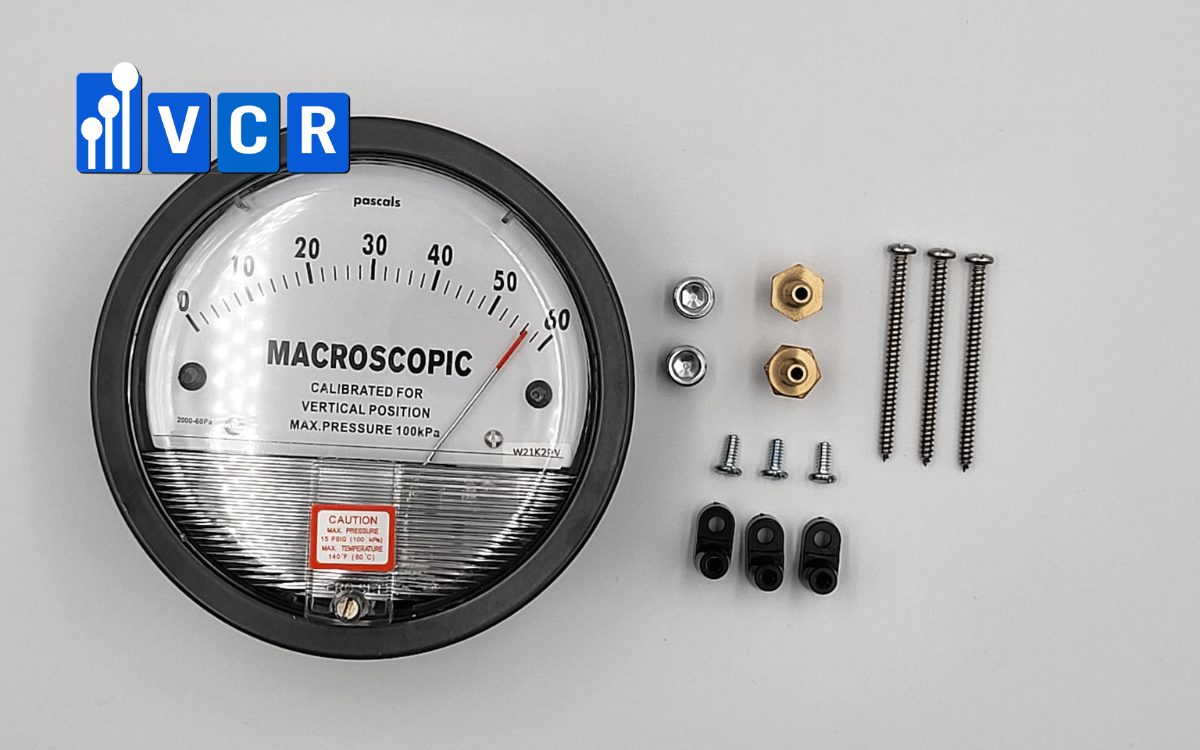
The Macroscopic 0–60 Pa differential pressure gauge is a mechanical pointer instrument for low room-pressure differences. It requires no electrical supply and is suitable for pharmaceutical cleanrooms, electronics facilities, laboratories, airlocks and other pressure-controlled spaces.
- What is the Macroscopic 0–60 Pa gauge?
- Published technical specifications
- Operating principle
- Why is 0–60 Pa suitable for room pressure?
- Pharmaceutical cleanroom applications
- Electronics and semiconductor facilities
- Laboratories and testing centres
- Can it monitor a HEPA filter?
- Comparison with other ranges
- Supplied accessories
- Installation
- Zero checking
- Calibration
- GMP suitability
- Advantages
- Limitations
- When should this model be selected?
- Frequently asked questions
- Conclusion
What is the Macroscopic 0–60 Pa gauge?
The Macroscopic 0–60 Pa differential pressure gauge is a mechanical pointer instrument that measures the pressure difference between two locations.
It receives pressure through separate High and Low ports and displays the resulting difference on a graduated dial.
The 0–60 Pa scale is intended for low differential-pressure applications. It is commonly considered for measurements between a cleanroom and corridor, between adjacent rooms, between an airlock and production area or between a changing room and clean corridor. VCR’s technical information identifies the 0–60 Pa scale mainly as a room-pressure range.
The instrument requires no external electrical supply for indication. Operators can read the room-pressure condition directly without using a PLC, HMI or building-management system.
Published technical specifications
According to VCR’s product information, the Macroscopic 0–60 Pa gauge has the following published specifications.
| Parameter | Published value |
|---|---|
| Brand | Macroscopic |
| Product series | Series 2000 |
| Measuring range | 0–60 Pa |
| Published accuracy | ±4% of full scale at 21°C |
| Published pressure limit | −20 inHg to 15 PSI |
| Operating temperature | Approximately −6.7 to 60°C |
| Weight | Approximately 560 g |
| Pressure connection | 1/8-inch NPT |
| Published origin | China |
| Display | Mechanical pointer |
| Electrical supply | Not required |
An accuracy of ±4% of full scale corresponds to a nominal value of approximately ±2.4 Pa for a 0–60 Pa instrument under the stated condition.
The project designer should determine whether this uncertainty is suitable for the room operating range and alarm limits.
Operating principle
The instrument converts pressure difference into mechanical pointer movement.
When pressure at the High port exceeds pressure at the Low port, the sensing element moves. This movement is transferred through a magnetic mechanism to the pointer.
VCR describes the product as using frictionless magnetic components for air and compatible non-corrosive gases.
The basic relationship is:
Differential pressure = High-port pressure − Low-port pressure
For a positive-pressure cleanroom operating 15 Pa above a corridor, the High port connects to the cleanroom and the Low port to the corridor. The gauge then indicates approximately 15 Pa under stable operating conditions.
Why is 0–60 Pa suitable for room pressure?
Cleanroom pressure differences are normally much lower than filter pressure drops.
A 0–60 Pa range provides greater pointer movement for small changes than a 0–500 Pa or 0–750 Pa gauge.
If a wide-range filter gauge is used for a room operating at only a few tens of pascals, the pointer remains near the bottom of the scale and important variations become difficult to recognise.
The 0–60 Pa gauge should only be selected when the maximum expected value, including normal fluctuation, remains within the scale.
Where room pressure may approach or exceed 60 Pa, a 0–125 Pa model may provide more operating margin.
Pharmaceutical cleanroom applications
The gauge may be installed between a pharmaceutical production room and a corridor, between rooms of different cleanliness levels or at an airlock.
It allows personnel to determine whether the HVAC system is maintaining the approved pressure relationship.
A decreasing value may be associated with an open door, supply and return imbalance, fan deterioration, damper movement or room leakage.
The gauge does not establish GMP compliance by itself. It must be correctly selected, installed, calibrated and included in the facility’s operating and inspection procedures.
Critical points requiring continuous records and alarms normally require an electronic transmitter in addition to or instead of the mechanical gauge.
Electronics and semiconductor facilities
Electronics and semiconductor facilities often maintain positive pressure to reduce the entry of airborne contamination.
The Macroscopic 0–60 Pa gauge can provide local indication at cleanrooms, changing rooms, airlocks and clean corridors.
Where particle or airborne molecular contamination control is critical, the mechanical gauge may be used as a local backup while an electronic transmitter supplies the primary monitoring system.
Laboratories and testing centres
Microbiology laboratories, PCR rooms, sample-preparation areas and testing centres may require controlled airflow direction to reduce cross-contamination.
For positive-pressure rooms, the High port connects to the protected room and the Low port to the adjacent area.
The gauge can also display the magnitude of negative room pressure when its High port is connected to the higher-pressure corridor and the Low port to the negative room.
However, a 0–60 Pa scale does not directly display a negative sign. A −60 to +60 Pa bidirectional gauge is more suitable where operators need to observe both pressure direction and magnitude.
Can it monitor a HEPA filter?
A 0–60 Pa range is generally not the preferred choice for HEPA filter loading.
Many HEPA filters have initial or final resistance greater than 60 Pa. The pointer could therefore reach or exceed full scale.
VCR’s published guidance primarily identifies 0–60 Pa for room pressure, while wider scales such as 0–250 Pa, 0–500 Pa and 0–750 Pa are associated with filters and cleanroom equipment.
The 0–60 Pa model should only be applied to a filter when its complete qualified operating range remains below 60 Pa.
Comparison with other ranges
A −60 to +60 Pa gauge shows both negative and positive pressure and is better suited to rooms where pressure direction may reverse.
A 0–125 Pa gauge provides more capacity for higher room pressures and operating fluctuation but may provide less visible movement at very low values.
A 0–250 Pa gauge may suit higher-pressure applications or certain low-resistance filters.
The 0–500 Pa and 0–750 Pa ranges are more appropriate for HEPA filters, AHUs, FFUs and components with greater pressure loss.
Supplied accessories
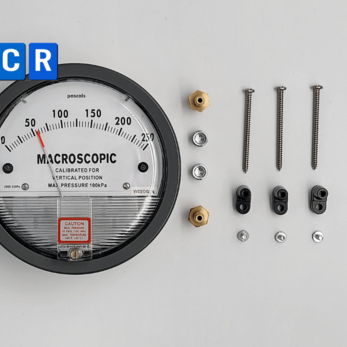
VCR’s product listing describes a package that may include the gauge, 1/8-inch NPT fittings, NPT blocks, rubber mounting feet and installation screws. The actual supply scope should be confirmed in the quotation and delivery documentation.
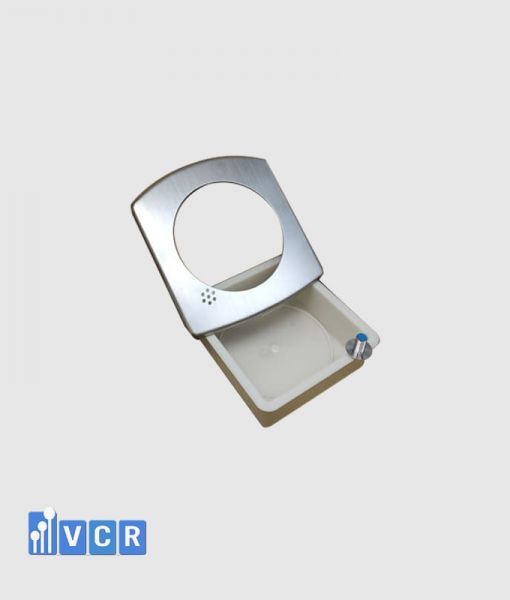
A complete room installation may additionally require pressure tubing, wall pressure taps, a flush-mounting enclosure, labels and sealing materials.
Installation
The higher-pressure location should be connected to the High port and the lower-pressure location to the Low port.
For a positive cleanroom, High normally connects to the cleanroom and Low to the corridor.
The gauge should be mounted vertically, in a visible position and away from excessive vibration.
Published installation instructions for this product family refer to 1/8-inch NPT fittings, rubber mounting feet and mechanical fasteners.
Pressure taps should be located away from supply diffusers, return grilles, fans and turbulent airflow.
Tubing should be airtight, free from kinks and protected from condensation. Wall penetrations should be sealed to avoid creating an air-leak path.
The pointer should be checked at zero before the pressure tubes are connected.
Zero checking
Zero can only be checked when the High and Low ports are exposed to equal pressure.
Both tubes should normally be disconnected so that both ports experience the same ambient condition.
Stopping the fan while leaving tubing connected does not necessarily establish zero because natural pressure, exhaust systems or trapped pressure may remain.
A small zero offset may be adjusted using the manufacturer’s zero mechanism after the gauge has been mounted in its normal orientation.
Zero adjustment is not calibration.
Calibration
Calibration compares the gauge indication with a known differential-pressure reference at several values.
For a 0–60 Pa gauge, calibration points should cover zero, the normal operating zone, mid-range and the upper portion of the scale, according to the project requirement.
A calibration certificate should identify the device, model, serial number, range, units, method, reference equipment, standard values, indicated values, errors and measurement uncertainty.
The serial number or asset identification on the certificate should correspond to the actual installed device.
GMP suitability
The Macroscopic 0–60 Pa gauge may be used in a GMP project when its range, accuracy, installation and calibration meet the approved user requirements.
GMP suitability is not determined only by brand, CO or CQ documentation.
The facility should verify that the range is correct, the uncertainty is suitable, pressure taps are representative, calibration is traceable and operating personnel have an approved inspection and response procedure.
Critical pressure points requiring continuous monitoring should use an electronic transmitter or a combined mechanical and electronic arrangement.
Advantages
The main benefits are straightforward local indication, no electrical supply and a scale suitable for low cleanroom pressure differences.
The mechanical construction simplifies panel and wall installation.
VCR describes the magnetic mechanism as frictionless, helping reduce mechanical contact within the transmission arrangement.
The 0–60 Pa range provides clearer indication of small room-pressure changes than wider filter-gauge scales.
Limitations
The standard mechanical configuration does not record data, generate alarms or directly communicate with a BMS or EMS.
The range is too low for many filter applications and does not directly display negative pressure.
Results depend on viewing angle, pressure-tap location, tubing integrity and correct mounting orientation.
The published accuracy for the 0–60 Pa version is ±4% of full scale at 21°C. The facility should assess this against its actual operating limits.
When should this model be selected?
The Macroscopic 0–60 Pa gauge is appropriate when the application involves a low positive pressure difference, local indication is sufficient and the maximum expected value remains below 60 Pa.
Typical locations include pharmaceutical cleanrooms, electronics rooms, laboratories, airlocks, changing rooms and clean corridors.
Another range or an electronic transmitter should be selected where negative and positive pressure must both be displayed, automatic alarms are required, data must be stored or the normal value approaches the upper end of the scale.
Frequently asked questions
What is the main use of the 0–60 Pa model?
It is mainly used for low differential pressure between a cleanroom and an adjacent area.
Does the gauge require electrical power?
No. The basic pointer indication is mechanical.
Can it measure a negative-pressure room?
It can display the pressure magnitude when High and Low are connected appropriately, but it does not show a negative sign. A bidirectional model is more informative.
Can it monitor a HEPA filter?
Only when the complete filter-pressure range remains below 60 Pa. Wider gauges are normally required.
Does it require calibration?
Calibration is recommended or required where the point affects GMP, quality, qualification or facility measurement control.
Is zero adjustment the same as calibration?
No. Zero adjustment verifies one point, while calibration evaluates several points across the range.
Can it connect directly to a BMS?
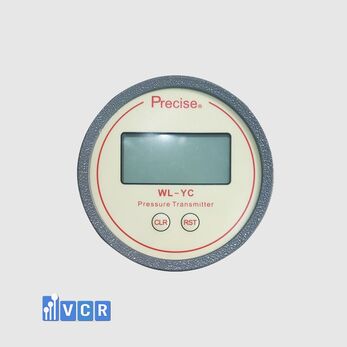
The basic mechanical model has no electrical output. A separate transmitter is required.
Conclusion
The Macroscopic 0–60 Pa differential pressure gauge is intended for low-pressure measurements in cleanrooms and controlled environments.
It provides direct local indication without electrical power and is suitable for cleanrooms, corridors, airlocks and changing rooms.
Reliable results depend on correct range selection, High–Low connection, pressure tapping, tubing integrity, zero checking and calibration.
For critical GMP points requiring alarms and historical records, the gauge should be combined with an electronic differential pressure transmitter.
VCR Cleanroom Equipment supplies Macroscopic 0–60 Pa gauges, installation accessories and calibration solutions for pharmaceutical, electronics, food, hospital and laboratory cleanrooms. VCR also supports range selection, pressure-tap design, installation and commissioning.