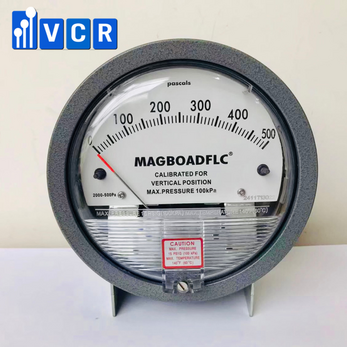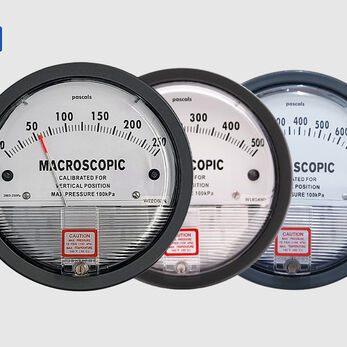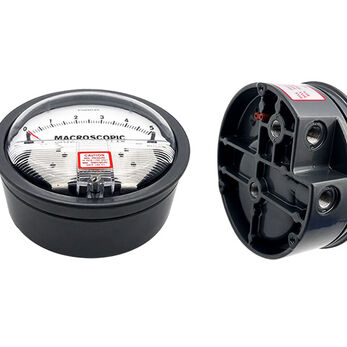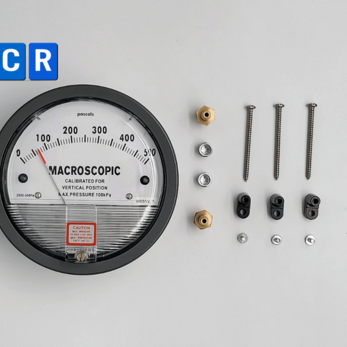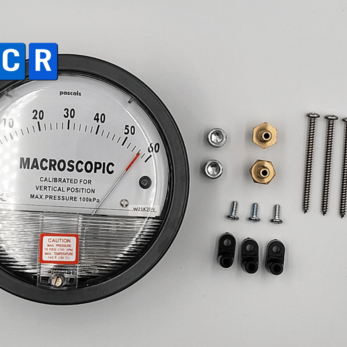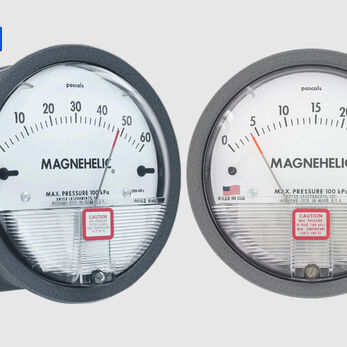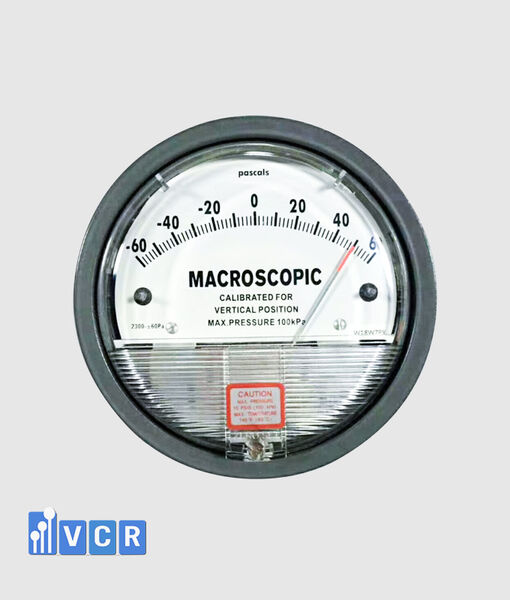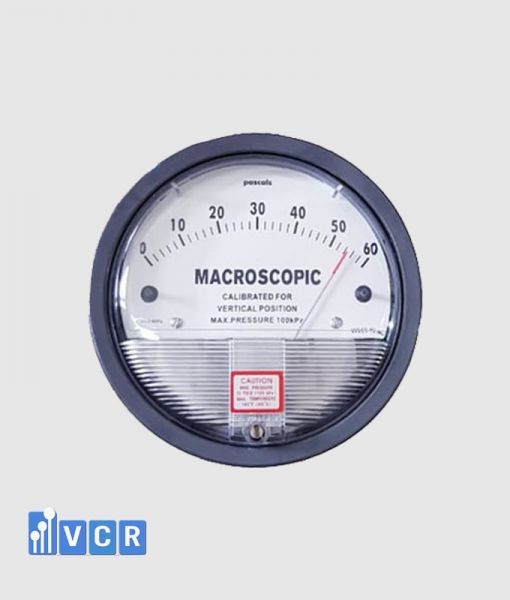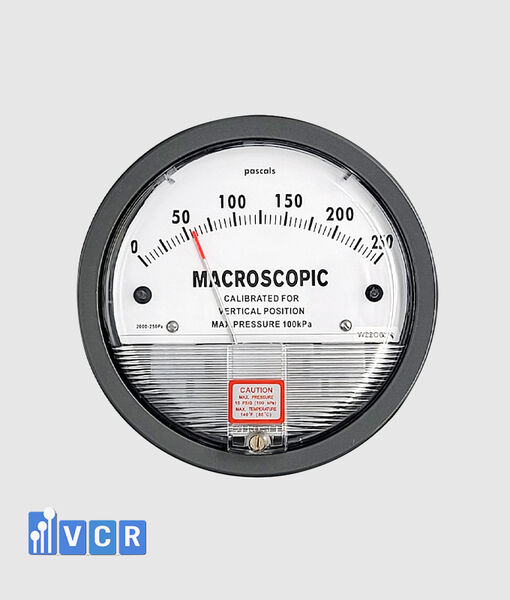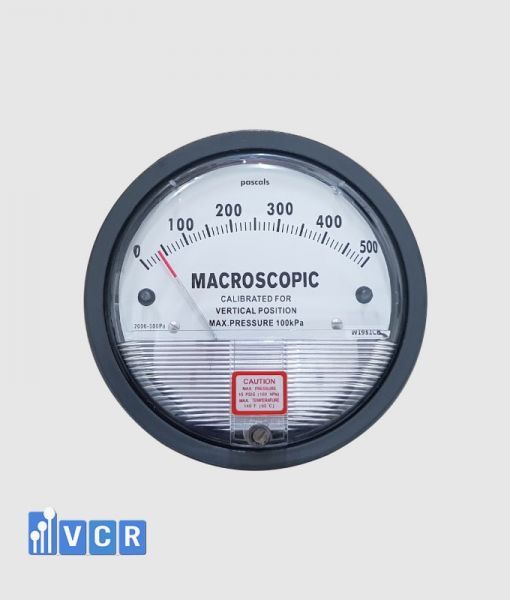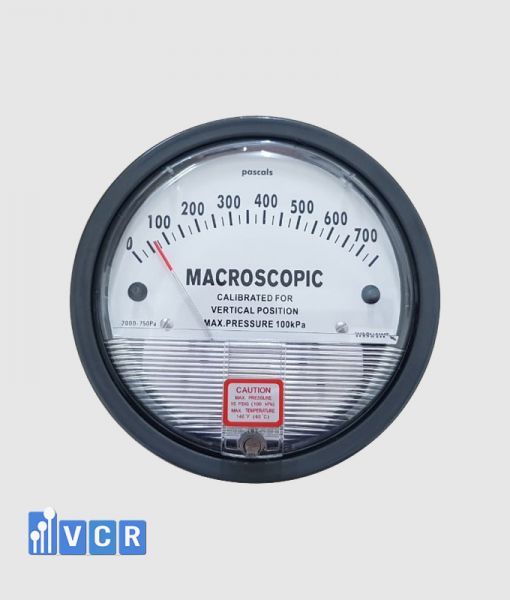

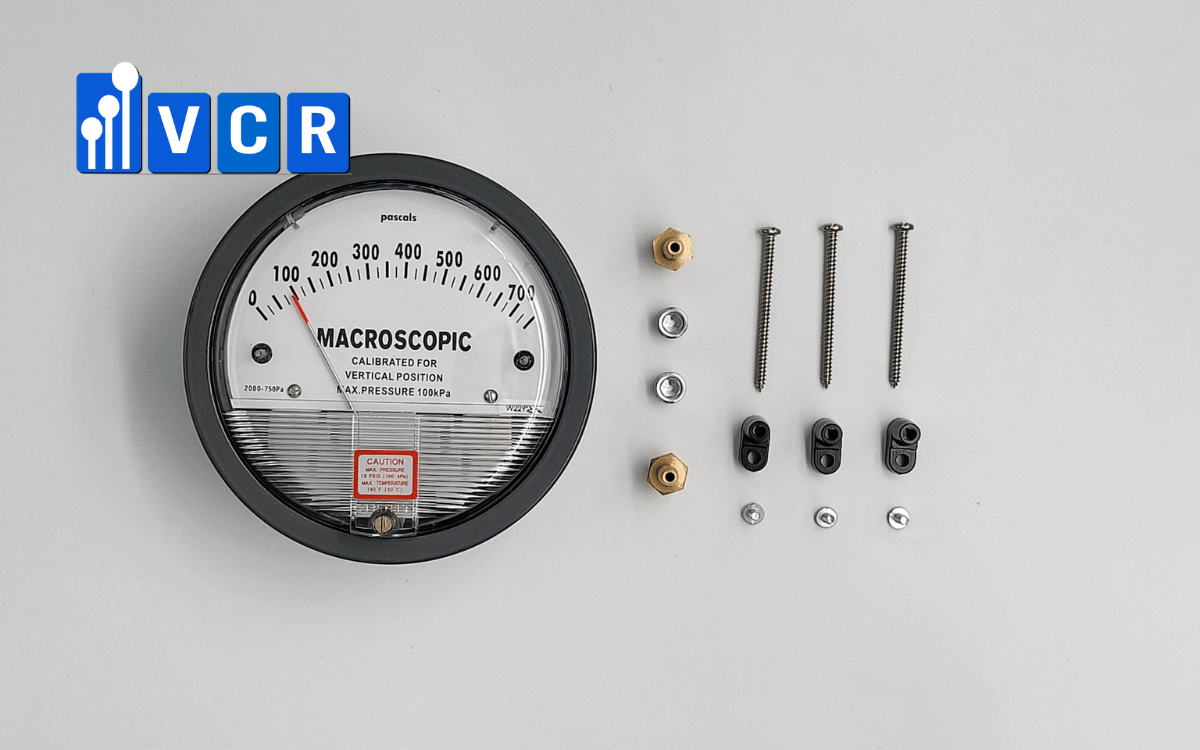
The Macroscopic 0–750 Pa differential pressure gauge is a mechanical pointer instrument for monitoring HEPA filters, HEPA boxes, AHUs, FFUs and HVAC equipment. Its wide measuring range requires no electrical power and is suitable for higher differential-pressure applications.
- What is the Macroscopic 0–750 Pa gauge?
- Published specifications
- Operating principle
- Suitable applications
- HEPA filter monitoring
- Does the gauge verify HEPA integrity?
- Is 750 Pa the filter-replacement limit?
- HEPA box application
- AHU application
- FFU application
- Pass box, air shower and LAF applications
- Can it be used for cleanroom pressure?
- Comparison with 0–250 Pa
- Comparison with 0–500 Pa
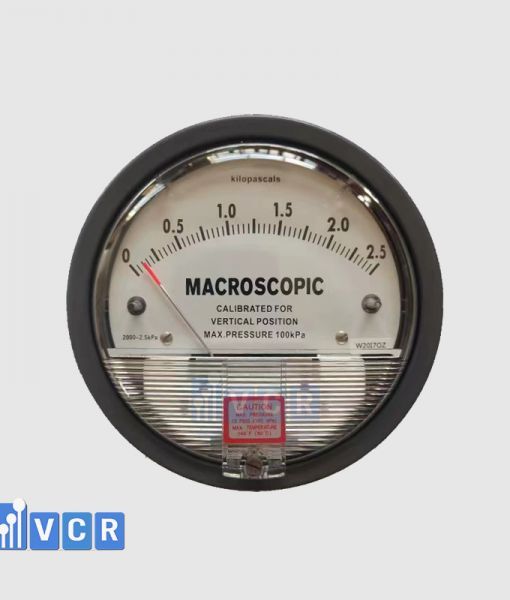
- Comparison with 0–2,500 Pa
- Installation
- Zero checking
- Calibration
- GMP suitability
- Advantages
- Limitations
- Purchasing checks
- Frequently asked questions
- What is the main application?
- Can it measure cleanroom room pressure?
- Is it suitable for a HEPA box?
- Does it require electrical power?
- Does it provide a 4–20 mA output?
- What is its published accuracy?
- What is the reference price?
- Must the filter be replaced at 750 Pa?
- Does zero adjustment replace calibration?
- Conclusion
What is the Macroscopic 0–750 Pa gauge?
The Macroscopic 0–750 Pa differential pressure gauge is a mechanical pointer instrument that measures the pressure difference between two locations in an air or compatible non-corrosive gas system.
The High port connects to the higher-pressure location, while the Low port connects to the lower-pressure location. The difference between these pressures is converted into pointer movement on the graduated dial.
The 0–750 Pa scale is a relatively wide range intended mainly for higher pressure-drop applications, including HEPA and ULPA filters, HEPA boxes, FFUs, AHUs and filter banks in cleanroom HVAC systems. It is normally unsuitable for room-pressure differences of only a few tens of pascals because the pointer movement would be very small.
The basic gauge requires no external electrical power and is suitable where straightforward local indication is sufficient.
Published specifications
According to VCR’s published product information, the instrument belongs to the Macroscopic Series 2000 and has the following principal specifications.
| Parameter | Published value |
|---|---|
| Brand | Macroscopic |
| Product series | Series 2000 |
| Measuring range | 0–750 Pa |
| Display | Mechanical pointer |
| Published accuracy | ±2% of full scale at 21°C |
| Pressure limits | −20 inHg to 15 PSI |
| Operating temperature | Approximately −6.7 to 60°C |
| Medium | Air or compatible non-corrosive gases |
| Pressure connection | 1/8-inch NPT |
| Electrical supply | Not required |
| Published weight | Approximately 0.51–0.56 kg |
The Vietnamese and English product pages currently show different weights, approximately 560 g and 510 g respectively. The current datasheet or packing list should therefore be confirmed where exact documentation is required.
An accuracy of ±2% of full scale corresponds to a nominal value of approximately ±15 Pa on a 0–750 Pa range.
This may be suitable for filter monitoring but is normally too large for room-pressure control points operating within a narrow low-pressure range.
Operating principle
The gauge responds to the pressure difference applied between its High and Low ports.
The differential force moves an internal sensing element. This movement is transferred to the pointer through a magnetic mechanism.
The supplier describes the design as using frictionless magnetic components and as suitable for positive, negative or differential pressure measurements with air and compatible non-corrosive gases.
The basic relationship is:
Differential pressure = High-port pressure − Low-port pressure
Across a filter, the High port is connected upstream and the Low port downstream.
Suitable applications
The 0–750 Pa gauge is suitable for pressure-drop points that are significantly higher than normal cleanroom room-pressure differences.
Typical applications include HEPA filters, ULPA filters, HEPA boxes, AHUs, FFUs, medium and fine filters, multi-stage filter banks and clean-air equipment. It may also be considered for LAF units, dispensing booths, dynamic pass boxes and air showers where the actual filter pressure drop is compatible with the range.
The equipment name alone should not determine the measuring range.
Two HEPA filters of the same nominal dimensions can have different pressure drops because of media area, rated airflow, construction and filter depth.
The selected range should therefore reflect clean-filter resistance, final resistance, operating airflow, fan capability and the required display resolution.
HEPA filter monitoring
HEPA filter monitoring is one of the main applications of the 0–750 Pa model.
As air passes through the filter media, pressure is lost in overcoming resistance. The gauge measures the difference between the upstream and downstream sides.
As dust and particles accumulate, resistance normally increases when airflow remains comparable. Recording the clean-filter value at the approved airflow provides a baseline for later comparison.
Pressure drop must be interpreted together with airflow and fan speed.
Reduced fan speed can lower the reading even when a filter is loaded. A variable-speed fan may increase its output to maintain airflow, resulting in a higher filter pressure drop while room airflow remains acceptable.
Does the gauge verify HEPA integrity?
No.
Differential pressure measures airflow resistance. It does not demonstrate that the filter media, seal or installation is leak-free.
A torn filter, leaking gasket or bypass path may still produce a differential-pressure reading.
HEPA integrity should therefore be assessed by an appropriate leak test. Filter pressure, airflow and integrity are related operating parameters but are not interchangeable tests.
Is 750 Pa the filter-replacement limit?
No.
The 750 Pa value is the upper limit of the gauge scale, not a universal filter-replacement setpoint.
Alert and replacement limits should be based on the filter datasheet, clean pressure drop, manufacturer’s recommended final resistance, required airflow, fan capability and qualified operating limits.
A filter may require action well before the pointer reaches 750 Pa.
HEPA box application
A HEPA box normally contains a terminal HEPA filter before clean air enters the room.
The 0–750 Pa gauge may monitor pressure between the upstream plenum and the downstream side of the filter.
The pressure taps should represent static pressure and be installed where the reading is not dominated by local turbulence.
The range is suitable when the clean-to-final operating pressure, including required margin, remains within 750 Pa. VCR identifies HEPA boxes as one of the principal applications for this range.
Where the complete operating range remains below approximately 200 Pa, a 0–250 Pa gauge may provide clearer indication.
AHU application
In an AHU, the gauge may be installed across a HEPA filter, a high-resistance fine filter or several filter stages.
Separate gauges should be considered when maintenance personnel need to identify which individual filter stage is loaded.
One gauge across several filters only indicates the combined pressure loss.
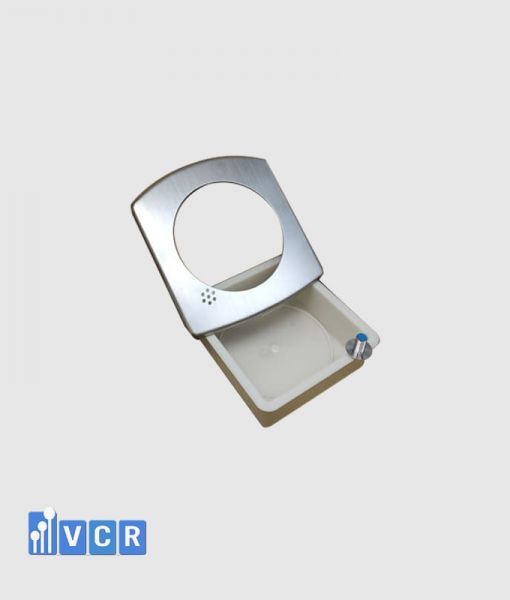
The product can be installed on an AHU faceplate and connected to upstream and downstream pressure taps using suitable tubing. VCR publishes dedicated AHU mounting accessories for differential pressure gauges.
Excessive casing vibration should be avoided because it can cause pointer fluctuation and reduce reading clarity.
FFU application
An FFU combines a fan with a HEPA or ULPA filter.
The 0–750 Pa model may be used when the filter operating range is compatible with the gauge scale.
For variable-speed FFUs, the reading should be evaluated together with fan speed and airflow.
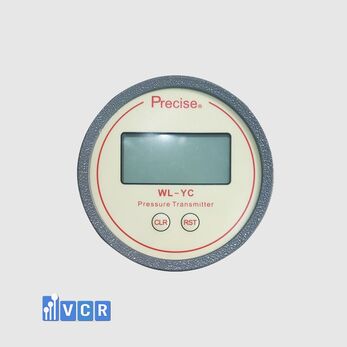
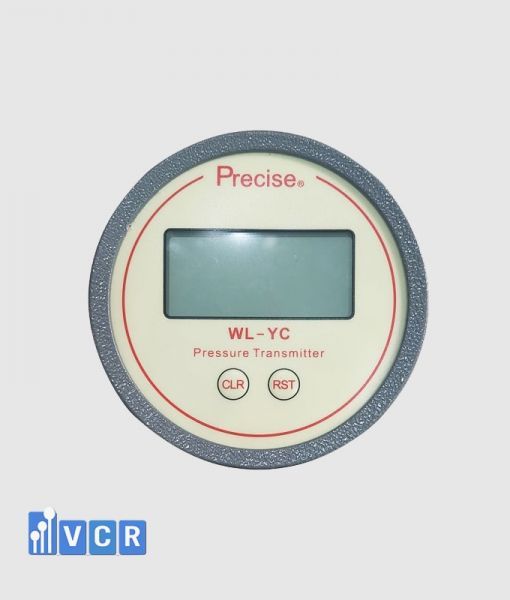
Where central monitoring or dirty-filter alarms are required, a separate electronic differential pressure transmitter should be installed.
Pass box, air shower and LAF applications
Dynamic pass boxes, air showers and laminar airflow equipment commonly include HEPA filters.
The gauge can monitor filter resistance where the clean and final pressure values fall within the 0–750 Pa scale.
For equipment with multiple filter stages, the design should identify whether the gauge measures one filter or the total filter bank.
In a dispensing or weighing booth, the 0–750 Pa gauge may monitor a high-resistance filter or plenum pressure. It should not replace a lower-range instrument required for room-pressure measurement.
Can it be used for cleanroom pressure?
It is generally not recommended.
Cleanroom-to-corridor, airlock and changing-room pressure differences are normally only a small fraction of the 750 Pa full scale.
The pointer would move very little, making small pressure changes difficult to recognise.
VCR’s published guidance recommends more sensitive ranges such as 0–60 Pa or 0–125 Pa for room pressure and identifies 0–750 Pa primarily with filters and higher-resistance HVAC equipment.
The ±2% full-scale accuracy also corresponds to approximately ±15 Pa, which may equal or exceed the complete design pressure difference of some rooms.
Comparison with 0–250 Pa
The 0–250 Pa model is more suitable when the complete operating and final pressure range remains below its scale.
It produces greater pointer movement and better visibility for moderate pressure changes.
The 0–750 Pa model is more appropriate where final pressure may reach several hundred pascals.
Comparison with 0–500 Pa
A 0–500 Pa gauge normally provides better display resolution in medium-pressure applications.
The 0–750 Pa model provides additional capacity for filters or filter banks with higher final resistance.
The wider scale should only be selected when the expected maximum pressure requires it.
Comparison with 0–2,500 Pa
A 0–2,500 Pa model is intended for substantially higher pressure-loss systems.
Using it for a filter operating below 500 Pa would provide limited pointer movement.
The 0–750 Pa range offers a more balanced scale for many medium-to-high-resistance HEPA and HVAC applications.
Installation
Across a filter, the High port should connect upstream and the Low port downstream.
Pressure taps should represent static pressure and should not be installed directly in high-velocity or highly turbulent airflow near fans, dampers or supply openings.
Tubing should be airtight, free from kinks and protected against condensation. High and Low lines should be clearly labelled.
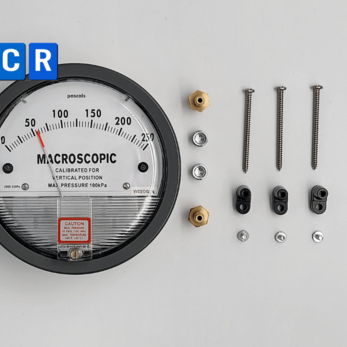
The product uses 1/8-inch NPT connections and may be connected to suitable rubber tubing. Published accessories include NPT fittings, port blocks, mounting screws and rubber feet.
The gauge should be mounted vertically, in a visible location and away from excessive vibration.
The pointer should be checked at zero before the pressure lines are connected.
Zero checking
A true zero condition requires equal pressure at the High and Low ports.
Both pressure lines should normally be disconnected, or the ports should be equalised according to the manufacturer’s procedure.
Stopping the fan without disconnecting the tubing may leave trapped pressure in the filter housing or tubing.
Zero adjustment verifies only the zero point. It does not establish accuracy across the complete scale.
Calibration
Calibration compares the gauge indication with a known differential-pressure reference at several values.
The test points should cover the operating region and the scale, for example zero and several increasing and decreasing pressure points up to 750 Pa.
Testing in both directions helps identify hysteresis and return-to-zero performance.
The certificate should identify the instrument model, serial or asset number, range, units, reference values, indicated values, errors, uncertainty and acceptance result.
For GMP or critical measurements, the certificate must be traceable to the actual installed device.
GMP suitability
The Macroscopic 0–750 Pa gauge can be used in a GMP facility when it is suitable for the measurement duty and meets the approved range, accuracy, installation and documentation requirements.
GMP suitability is not determined by the brand, CO or CQ alone.
The facility should demonstrate correct range selection, representative pressure taps, calibration, approved inspection procedures and technically justified filter limits.
Critical points requiring alarms or continuous records should use an electronic transmitter in addition to or instead of the mechanical gauge.
Advantages
The wide range is suitable for many medium-to-high-resistance filters and HVAC applications.
The gauge requires no electrical supply and provides immediate local indication.
Published accuracy is ±2% of full scale at 21°C. The product description also identifies a frictionless magnetic movement, cast-aluminium housing and plexiglas display cover.
A recent public reference price is approximately VND 1.2–1.39 million per unit, depending on quantity, tax, accessories, documentation and calibration.
Limitations
The range is unsuitable for many low room-pressure measurements.
The nominal ±2% full-scale accuracy corresponds to approximately ±15 Pa and should be assessed carefully for narrow control limits.
The standard mechanical model does not log data, generate remote alarms or communicate directly with a BMS or EMS.
Readings depend on airflow, fan speed, tubing condition, pressure-tap location and mounting orientation.
The gauge does not replace HEPA integrity testing, airflow measurement or airflow visualisation.
Purchasing checks
Confirm the Macroscopic brand, 0–750 Pa range and Pa units.
Inspect the pointer, dial cover, zero adjustment, High and Low ports and supplied accessories.
Documentation requirements should be stated in the quotation, including the datasheet, warranty, invoice, CO, CQ and calibration certificate where required.
For projects with several instruments, prepare a schedule showing each location, measuring purpose and required range.
Frequently asked questions
What is the main application?
The gauge is mainly used across HEPA filters, ULPA filters, HEPA boxes, AHUs, FFUs and other high-resistance filter or HVAC applications.
Can it measure cleanroom room pressure?
It is generally not recommended. A lower range provides better readability and more appropriate accuracy for room pressure.
Is it suitable for a HEPA box?
Yes, when the clean-to-final filter pressure range remains below 750 Pa.
Does it require electrical power?
No. The basic pointer indication is mechanical.
Does it provide a 4–20 mA output?
The standard mechanical model does not. A separate electronic transmitter is required for PLC, HMI, BMS or EMS integration.
What is its published accuracy?
The published accuracy is ±2% of full scale at 21°C, equivalent to approximately ±15 Pa on the 0–750 Pa range.
What is the reference price?
The recent published reference price is approximately VND 1.2–1.39 million per unit, subject to quantity, tax, accessories, documentation and calibration.
Must the filter be replaced at 750 Pa?
No. The filter action limit must be based on its technical data and the qualified system operating conditions.
Does zero adjustment replace calibration?
No. Zero adjustment checks one point, while calibration verifies multiple values across the measuring range.
Conclusion
The Macroscopic 0–750 Pa differential pressure gauge is suitable for filter-pressure and higher differential-pressure applications in cleanroom systems.
Its wide scale supports many HEPA filters, HEPA boxes, AHUs, FFUs, LAF units, dynamic pass boxes and other HVAC equipment.
The range should not be applied automatically to every filter or cleanroom pressure point. Selection must consider clean-filter resistance, final resistance, design airflow, fan capability and required display resolution.
Reliable results require correct upstream and downstream connections, representative static-pressure taps, airtight tubing, proper mounting, zero checking and periodic calibration.
For GMP or critical measurements, the instrument should be identified, calibrated and included in the approved inspection programme. An electronic transmitter should be added where alarms, historical records or central monitoring are required.
VCR Cleanroom Equipment supplies Macroscopic 0–750 Pa differential pressure gauges, accessories, documentation and calibration solutions for HEPA boxes, AHUs, FFUs, LAF units, pass boxes, air showers, dispensing booths and cleanroom HVAC systems. VCR also supports range selection, pressure-tap design, installation and commissioning.