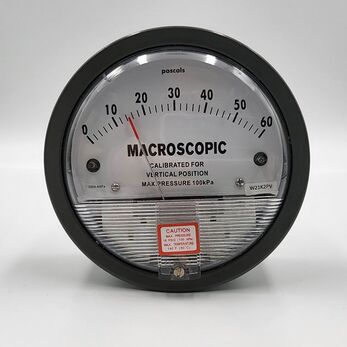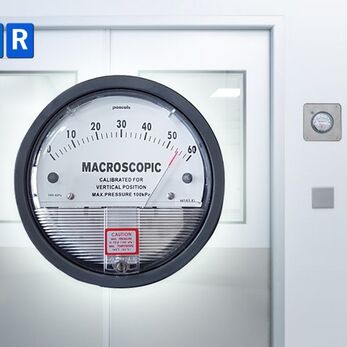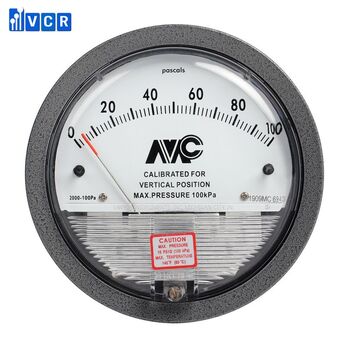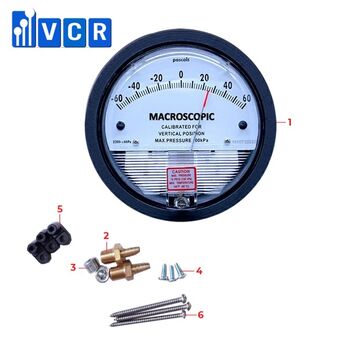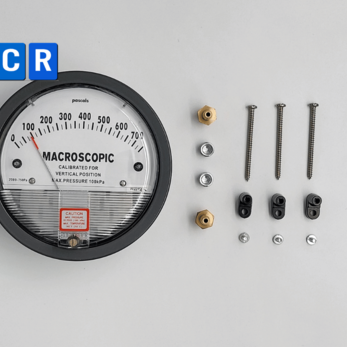

Differential pressure gauges help factories in Que Vo Industrial Park monitor cleanroom pressure, HEPA filter resistance and HVAC performance. Correct measuring range, accuracy, installation and calibration documentation are essential for stable environmental control.
- Demand for differential pressure gauges in Que Vo Industrial Park
- What is a differential pressure gauge?
- Importance of pressure differentials in factories
- Cleanroom pressure monitoring
- HEPA filter monitoring
- AHU and HVAC applications
- Applications on cleanroom equipment
- Common measuring ranges
- Mechanical and digital gauges
- Criteria for selecting a supplier in Que Vo Industrial Park
- Required technical documentation
- Common installation mistakes
- Pre-commissioning checks
- Frequently asked questions
- Where can factories in Que Vo Industrial Park buy differential pressure gauges?
- Can a room-pressure gauge be used across a HEPA filter?
- Is a gauge defective if it does not return to zero?
- How often should a differential pressure gauge be calibrated?
- Can a differential pressure gauge measure cleanroom cleanliness?
- Differential pressure gauge consultation for Que Vo factories
Demand for differential pressure gauges in Que Vo Industrial Park
Que Vo Industrial Park in Bac Ninh Province accommodates factories operating in electronics, components, precision engineering, food processing, industrial equipment and supporting industries. These manufacturing facilities increasingly require stable production environments, controlled airflow and effective monitoring of dust, temperature, humidity and pressure.
In cleanrooms and other controlled manufacturing areas, differential pressure gauges are used to measure the pressure difference between adjacent spaces. They are also installed across HEPA filters, fine filters and air-handling unit filtration stages to indicate changes in airflow resistance.
For cleanroom contractors and mechanical and electrical companies, gauge selection should not be based only on product dimensions or brand. The measuring range, display unit, accuracy, installation method, output signal and documentation must match the intended application.
Correct selection enables operators to identify abnormal pressure conditions, supports preventive maintenance and reduces the risk of operating outside the system design parameters.
What is a differential pressure gauge?
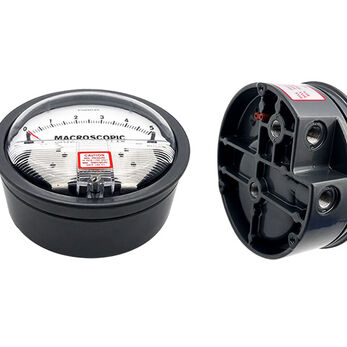
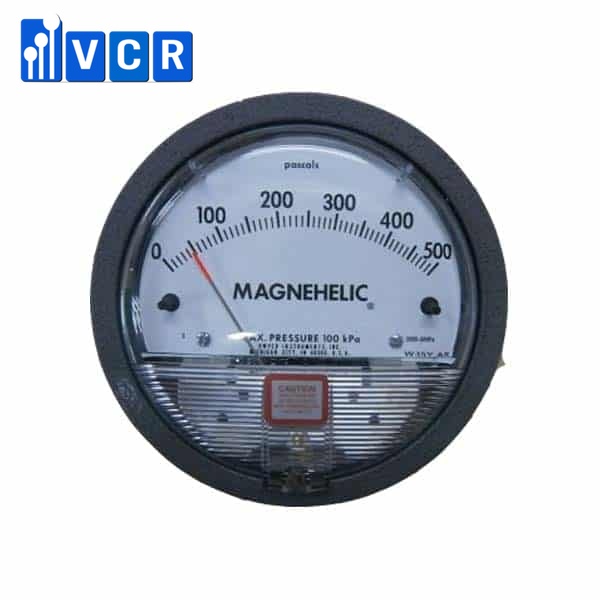
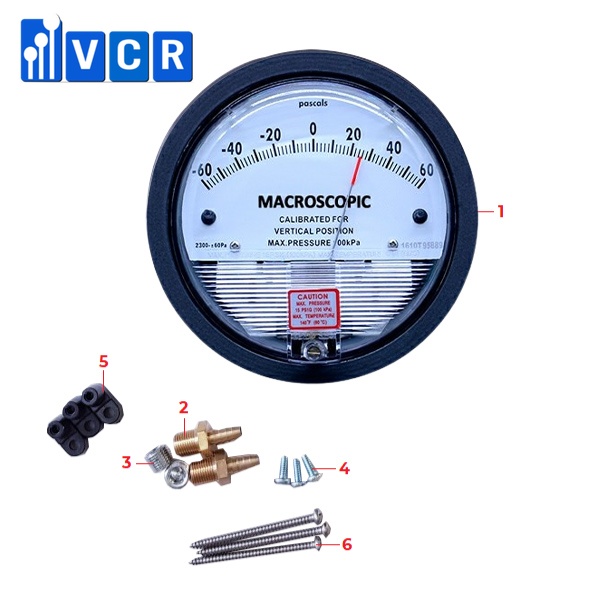
A differential pressure gauge measures the difference between two pressure points. The instrument normally includes a high-pressure port and a low-pressure port connected to the measuring locations through pressure tubing.
The indicated value represents the difference between the two pressures rather than the absolute pressure at either point. This measurement principle is suitable for room-pressure monitoring, filter-resistance indication and HVAC system assessment.
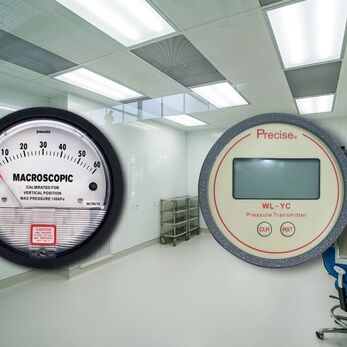
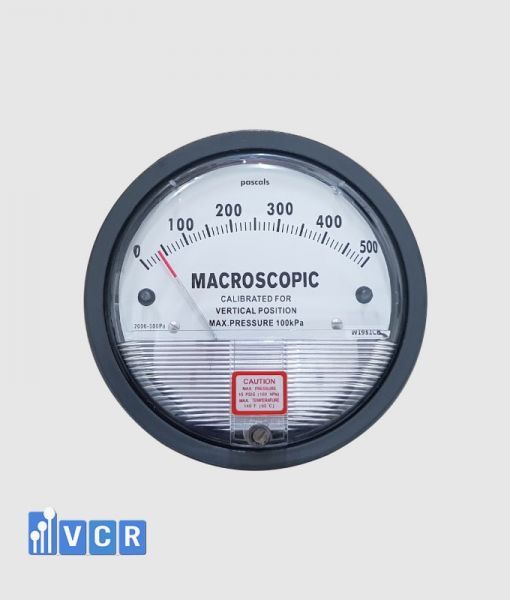
Differential pressure instruments are available in mechanical and digital forms. Mechanical gauges provide direct local indication and generally require no electrical power for basic operation. Digital gauges and transmitters can provide alarms, analogue outputs or communication with a PLC, building-management system or environmental-monitoring system.
Importance of pressure differentials in factories
Pressure differential is an important parameter for controlling airflow direction. When a room is maintained at a higher pressure than an adjacent area, air tends to move from the higher-pressure space to the lower-pressure space through leakage paths or open doors.
This principle is commonly applied to reduce the risk of uncontrolled air entering cleaner production areas. In containment applications involving dust, chemicals or potentially hazardous substances, a room may be operated under negative pressure to prevent contaminants from spreading outside.
The correct pressure differential depends on the manufacturing process, room cleanliness level, enclosure tightness, number of doors, door-opening frequency and the balance between supply and return airflow.
A differential pressure gauge allows operators to determine whether the system remains within the intended operating condition. However, the gauge does not regulate pressure unless it forms part of an automated control loop.
Cleanroom pressure monitoring
In factories in Que Vo Industrial Park, differential pressure gauges may be installed between a cleanroom and a corridor, between rooms of different cleanliness levels or between a production area and an airlock.
Mechanical gauges are normally placed where operators can read them before entering the controlled area or during routine inspections. For critical monitoring points, an electronic pressure sensor may transmit readings to a central system.
A low pressure differential may be caused by an open door, poor door sealing, reduced supply airflow, increased return airflow, filter resistance or unstable fan performance.
An unexpectedly high differential may result from changes in door status, damper position, airflow balance or filtration condition. The reading should therefore be evaluated together with the actual operating status of the HVAC system.
HEPA filter monitoring
One of the most common applications is monitoring the pressure drop across a HEPA filter. The pressure connections are installed upstream and downstream of the filter. As air passes through the filter media, resistance creates a measurable pressure difference.
Dust accumulation can increase filter resistance over time. The gauge allows maintenance personnel to observe the trend and plan inspections or filter replacement when necessary.
A high reading does not automatically mean that the HEPA filter is damaged. The increase may be caused by higher airflow, blocked pressure tubing, an unsuitable tapping point or a change in system conditions.
A low reading also does not confirm that the filter remains in good condition. A damaged filter, poor sealing or bypass airflow may reduce the pressure drop while compromising particle-control performance.
HEPA filter assessment should therefore combine differential pressure monitoring with integrity testing, airflow velocity measurement, airflow-volume testing and other required qualification activities.
AHU and HVAC applications
In an air-handling unit, differential pressure gauges may be installed across prefilters, medium-efficiency filters, fine filters or an entire filtration section. Each filtration stage may require a different measuring range.
If the selected range is too high, small changes in resistance become difficult to observe. If the range is too low, the pointer may exceed full scale or the gauge may operate outside its recommended pressure limit.
In systems with several filtration stages, pressure ports and tubing should be clearly labelled to prevent incorrect connections. Tubing must be installed without leakage, kinking or unnecessary low points where water could collect.
The initial pressure drop should be recorded after a new filter is installed and the system reaches its normal airflow. This baseline is essential for evaluating the increase in filter resistance during operation.
Applications on cleanroom equipment
Differential pressure gauges are also used on dynamic pass boxes, air showers, laminar airflow units, dispensing booths, sampling booths, biosafety cabinets, HEPA filter boxes and standalone filtration modules.
On a dynamic pass box, a gauge may indicate filter resistance or chamber pressure. On a dispensing booth or laminar airflow unit, it can monitor pressure drop across the terminal HEPA filter.
Each item of equipment has a different airflow rate, filter area and operating resistance. The same measuring range should not be used for every cleanroom product without checking the equipment design data.
Common measuring ranges
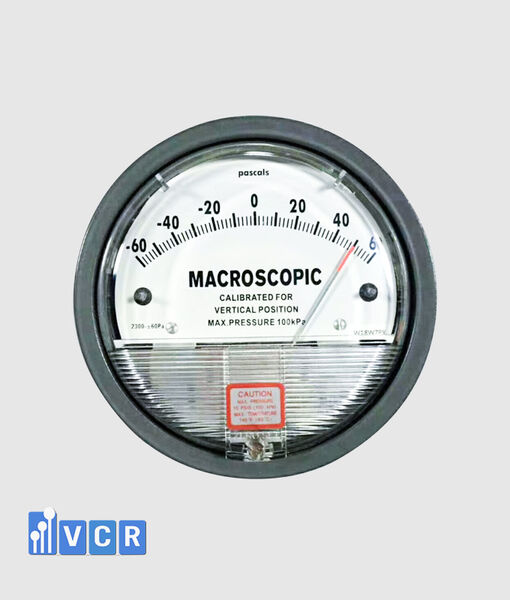
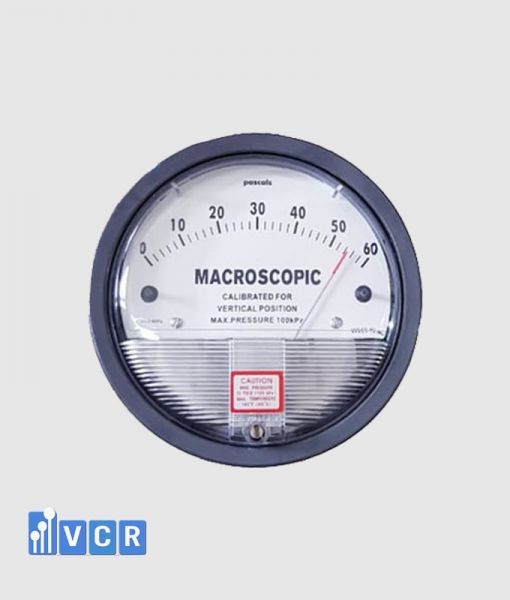
For cleanroom-pressure monitoring, relatively low ranges are generally preferred because they make small pressure variations easier to observe. Typical options may include 0–30 Pa, 0–60 Pa, 0–100 Pa or bidirectional ranges such as -30 to +30 Pa.
A bidirectional gauge is suitable when both negative and positive pressure conditions need to be displayed. Selection should be based on the normal operating value and alarm limits.
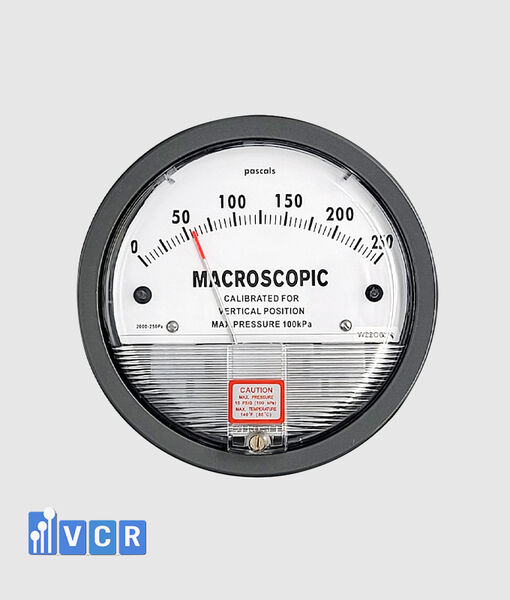
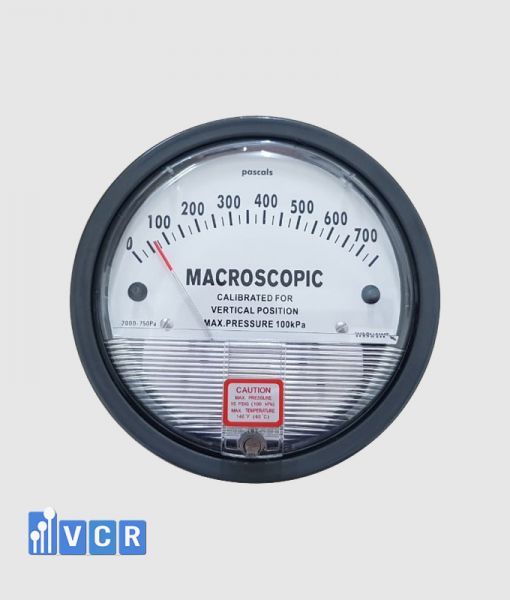
For HEPA filters and clean-air equipment, ranges such as 0–250 Pa, 0–500 Pa, 0–750 Pa or 0–1,000 Pa may be considered, depending on expected resistance.
AHU filtration stages may require larger ranges. The supplier should review the initial and final pressure-drop values provided by the filter manufacturer.
Mechanical and digital gauges
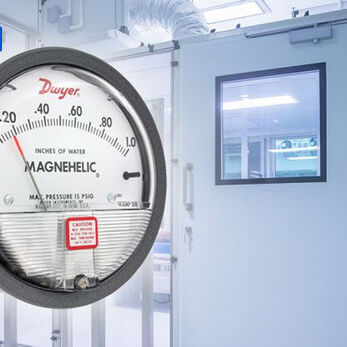
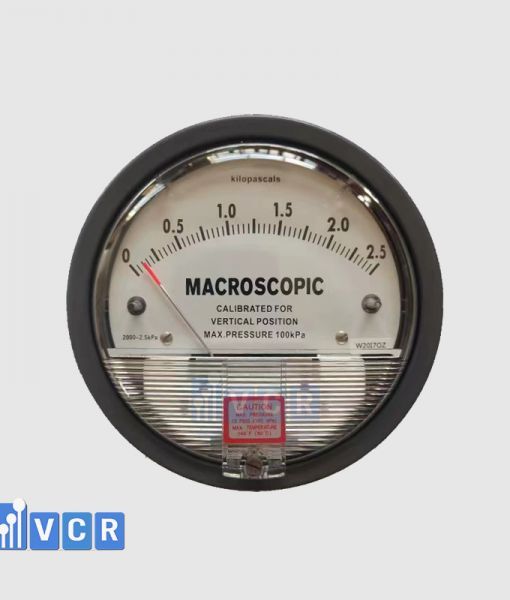
A mechanical differential pressure gauge is suitable where local indication is sufficient. It is easy to read, does not require an electrical supply and can be installed on a cleanroom wall or equipment panel.
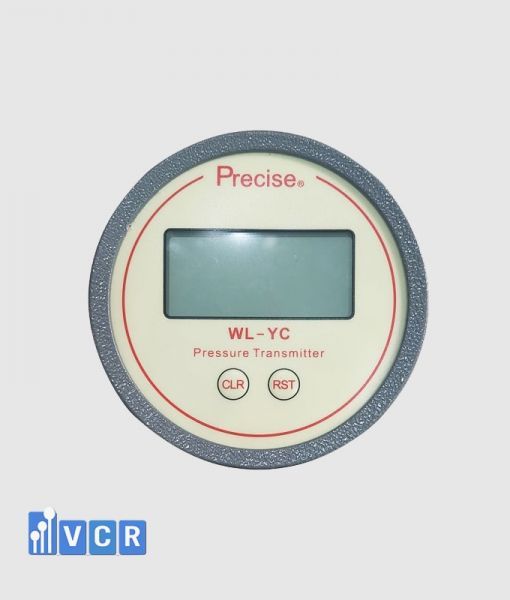
A digital differential pressure gauge or transmitter is more appropriate when alarms, data recording or signal transmission are required. Depending on the model, outputs may include 4–20 mA, 0–10 V, relay contacts or digital communication.
For continuous monitoring, an electronic transmitter allows the facility to record pressure trends over time. Historical data can support investigations when the pressure exceeds limits or an environmental-control incident occurs.
Digital instruments require a power supply, wiring, system configuration and control integration. The total project cost should therefore include the sensor, cables, control panel, programming and commissioning.
Criteria for selecting a supplier in Que Vo Industrial Park
A competent supplier should first identify the exact application. A gauge for room-pressure monitoring has different requirements from an instrument used to indicate filter resistance.
The supplier should confirm the expected operating pressure, maximum pressure, engineering unit, display type, dial size, mounting method and output-signal requirement.
For cleanroom projects, the supplier should also understand the relationship between differential pressure, supply airflow, return airflow, door tightness, interlocking systems and HVAC operating modes.
Vietnam Cleanroom Equipment, also known as VCR Cleanroom, supplies differential pressure gauges and cleanroom equipment to cleanroom contractors, MEP companies, system integrators and industrial factories. Equipment selection is based on the installation location, technical requirements and actual operating conditions.
Required technical documentation
Depending on the project, documentation may include a product catalogue, technical data sheet, installation instructions, certificate of origin, certificate of quality and calibration certificate.
A quality certificate is not equivalent to a calibration certificate. The calibration document should identify the instrument, serial number, calibration range, test points, measurement error and calibration conditions.
For projects operating under GMP, ISO or a strict quality-management system, documentation requirements should be agreed during the material-approval stage. This prevents situations where the gauge is technically suitable but cannot be accepted because the supporting documents are incomplete.
Common installation mistakes
Reversing the high-pressure and low-pressure ports is a frequent installation error. The pointer may fail to move, move in the wrong direction or display a value inconsistent with the actual system condition.
Kinked, leaking or blocked tubing can also produce incorrect readings. In humid environments, condensation may collect in the pressure line and affect measurement stability.
Some mechanical gauges should be installed in the intended orientation and on a reasonably level surface. Excessive inclination may shift the zero point.
Pressure taps should be located where they represent the static pressure of the room or duct. A tapping point placed too close to a supply grille, fan or high-velocity airflow may be influenced by dynamic pressure and provide an unrepresentative reading.
Pre-commissioning checks
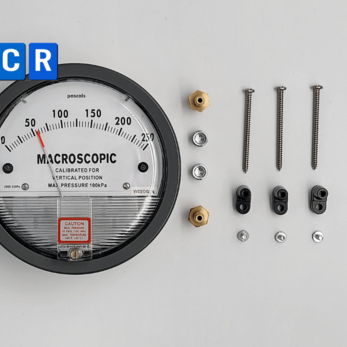
Before commissioning, the project team should verify the model, measuring range, display unit and mounting position. Both pressure ports should be connected correctly and clearly labelled.
When the two ports are exposed to the same pressure, the gauge should return to zero within its allowable tolerance. The HVAC system can then be operated to confirm the direction of indication and actual pressure value.
For digital instruments, the power supply, output signal, alarm setpoints and communication with the control system should also be tested.
Calibration alone does not validate the complete field installation. A correctly calibrated gauge may still provide an inaccurate system reading if the tubing is leaking, blocked or connected incorrectly.
Frequently asked questions
Where can factories in Que Vo Industrial Park buy differential pressure gauges?
Factories should choose a supplier with practical experience in cleanrooms and HVAC systems. The supplier should be able to recommend the measuring range, installation method, calibration documentation and suitable accessories rather than offering products based only on price.
Can a room-pressure gauge be used across a HEPA filter?
It can only be used when the range and pressure limit are suitable. Room-pressure gauges often have low measuring ranges, while HEPA filter resistance may be significantly higher.
Is a gauge defective if it does not return to zero?
Not necessarily. The user should check whether both ports are exposed to equal pressure, whether the tubing is blocked or contains water, whether the gauge is installed correctly and whether zero adjustment is required.
How often should a differential pressure gauge be calibrated?
The interval depends on the criticality of the measuring point, the quality-management system, manufacturer recommendations and historical calibration results. Many factories use a six-month or twelve-month interval, but the final frequency should be based on risk assessment.
Can a differential pressure gauge measure cleanroom cleanliness?
No. It only measures the pressure difference between two points. Cleanliness must be assessed by airborne particle counting and other relevant environmental tests.
Differential pressure gauge consultation for Que Vo factories
When requesting a technical recommendation or quotation, the factory or contractor should provide the installation location, expected pressure range, quantity, display type, output-signal requirement and documentation requirements.
Vietnam Cleanroom Equipment supplies differential pressure gauges for cleanrooms, AHUs, HEPA filters, dynamic pass boxes, dispensing booths and controlled-air equipment in Que Vo Industrial Park.
Defining the application clearly from the beginning helps select the correct model, reduces changes during installation and ensures that the gauge is suitable for the factory’s actual operating conditions.