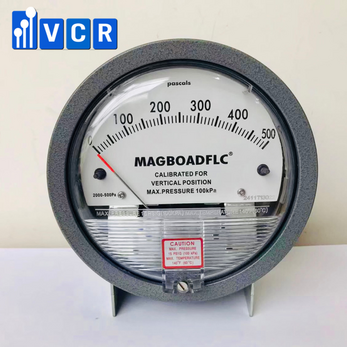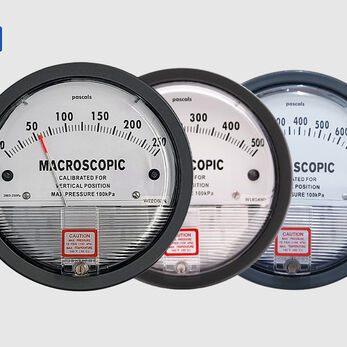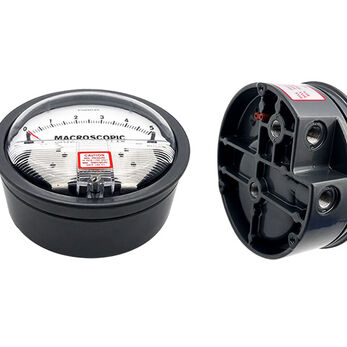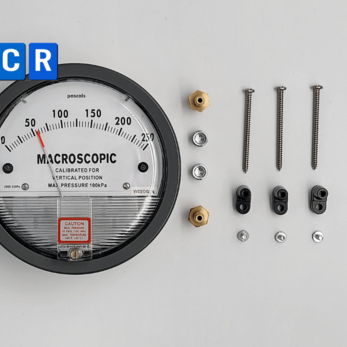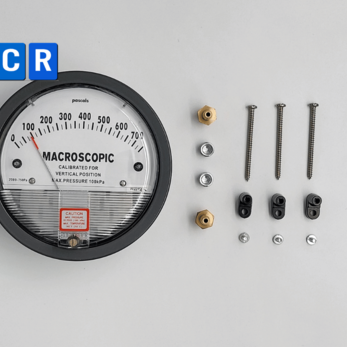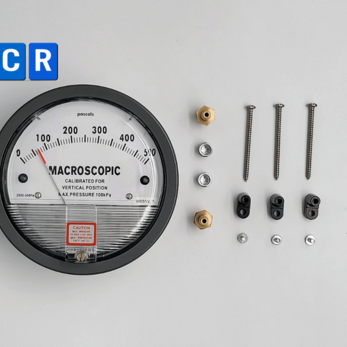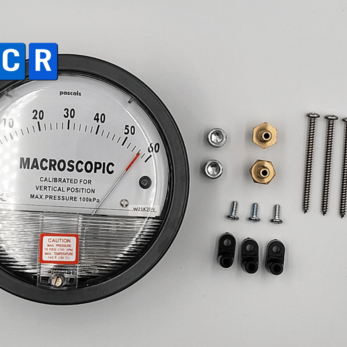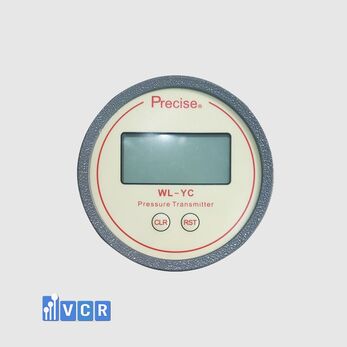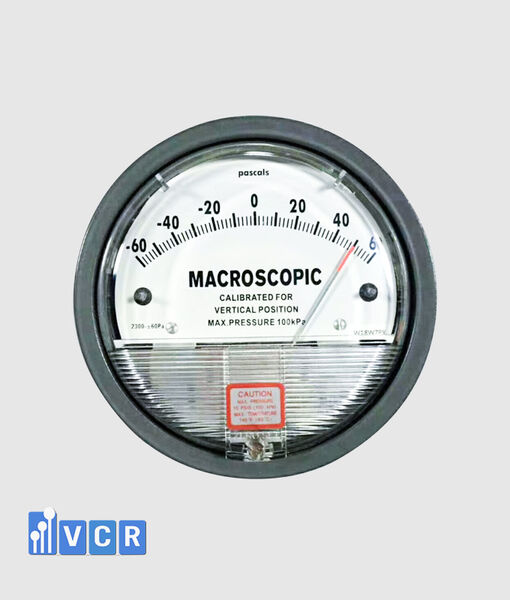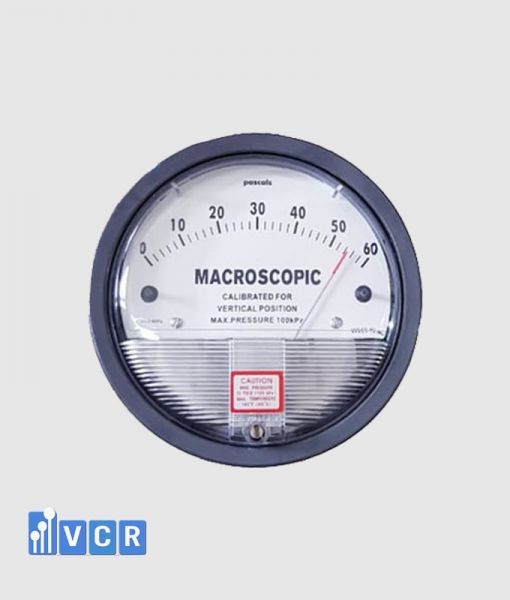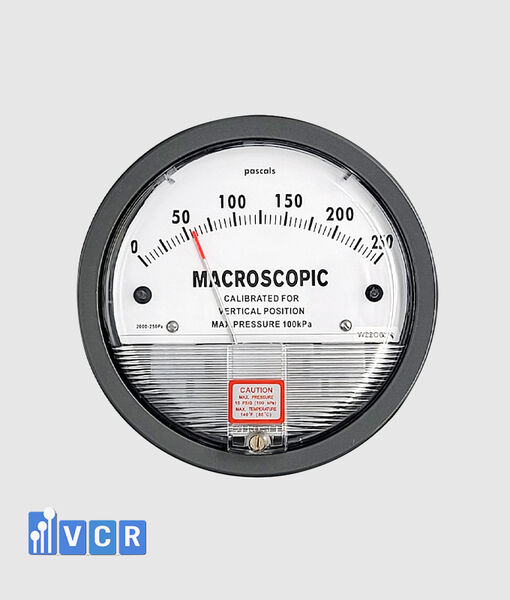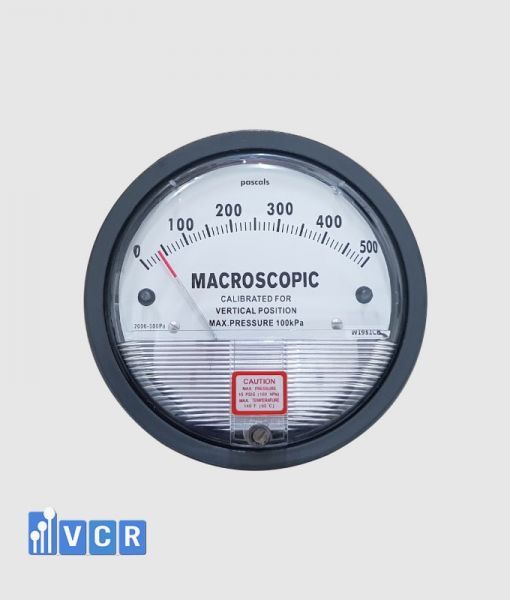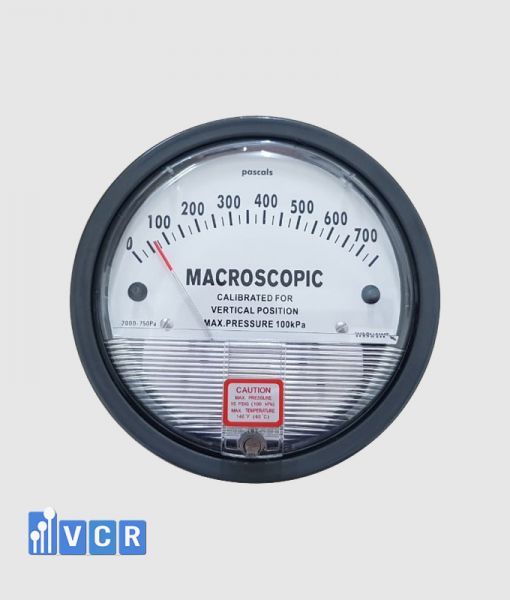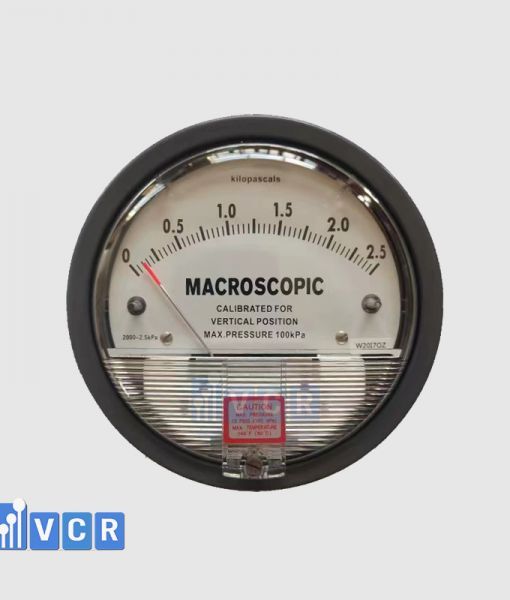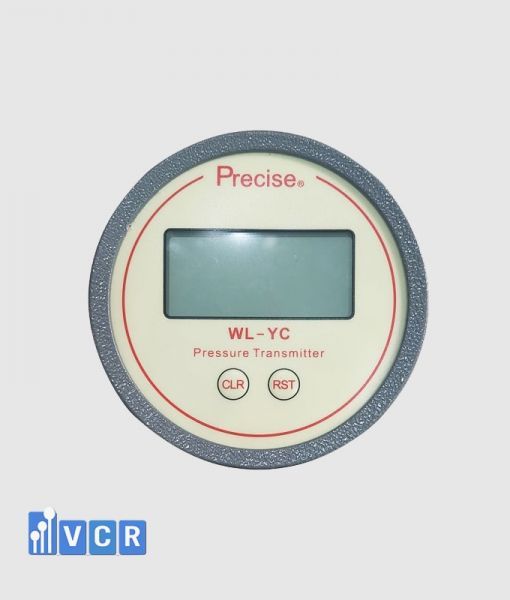

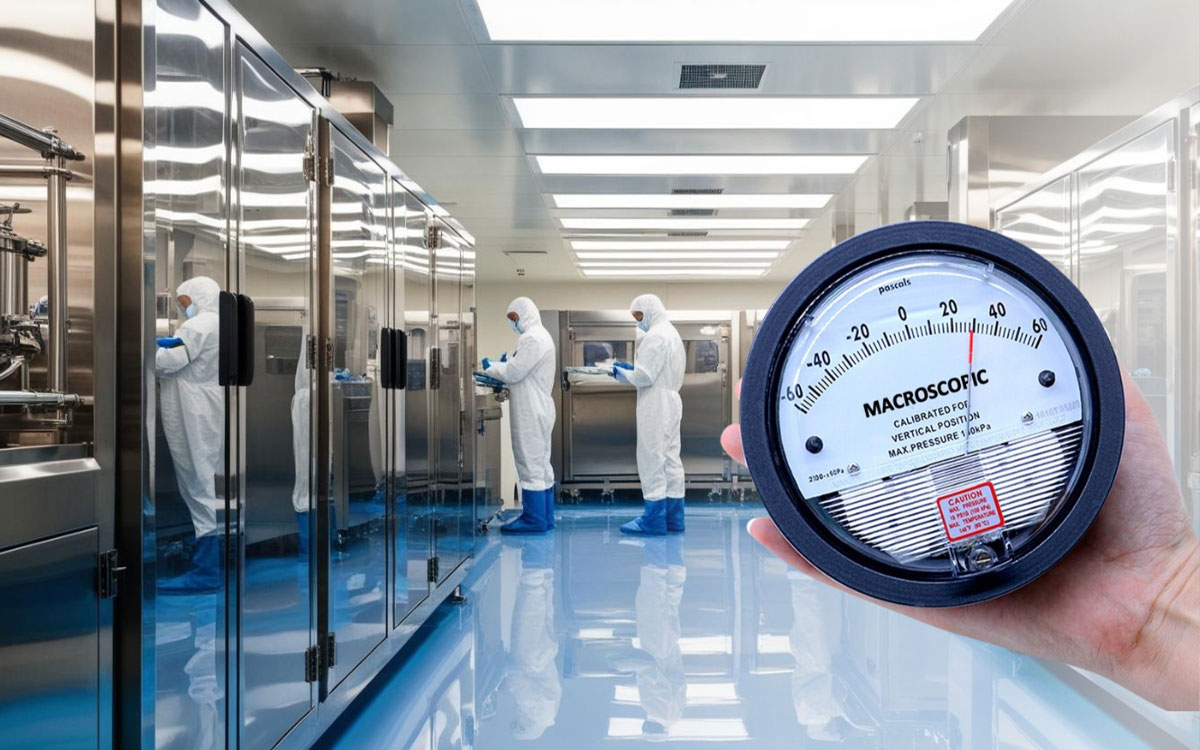
A differential pressure gauge helps control airflow direction between a Grade D cleanroom and adjacent areas. The instrument should be selected according to its measuring range, monitoring method, alarm functions and calibration requirements under EU GMP Annex 1.
- What is Grade D under EU GMP Annex 1?
- Why is differential pressure important in Grade D?
- What pressure differential does EU GMP require for Grade D?
- Does Grade D require continuous pressure monitoring?
- Can a mechanical differential pressure gauge be used?
- When should a 4–20 mA transmitter be selected?
- Selecting the measuring range
- Accuracy and zero stability
- Establishing Grade D pressure alarms
- Airlocks leading to Grade D
- Installation requirements
- Calibration and loop verification
- IQ and OQ qualification
- Grade D requalification
- Common mistakes
- FAQ: Grade D differential pressure gauges
- Grade D differential pressure solutions from VCR Cleanroom Equipment
Grade D is used for lower-risk stages in the manufacture of sterile medicinal products. Although it does not directly protect exposed sterile products in the same manner as Grade A, its environmental condition can influence the particulate, microbial and endotoxin burden of materials, components, equipment and solutions before later processing steps.
Differential pressure is one of the parameters used to maintain a Grade D cleanroom in a controlled state. A suitable gauge or transmitter helps confirm the intended direction of air movement, identify HVAC deterioration and demonstrate segregation between adjacent cleanliness areas.
Instrument selection should not be based only on price or on a standard range used throughout the facility. The intended measurement, criticality, recording method, alarm requirements and calibration documentation should be defined for each location.
What is Grade D under EU GMP Annex 1?
EU GMP Annex 1 describes Grade C and Grade D as cleanrooms used for less critical stages in the manufacture of aseptically filled sterile products. They may also be used as backgrounds for isolators or for the preparation of terminally sterilized products.
For terminally sterilized products, the preparation of components and materials should be performed in at least Grade D to limit microbial, endotoxin, pyrogen and particulate contamination before sterilization. Where the product presents a high or unusual microbial risk, preparation should be performed in at least Grade C.
Operations that may be performed in Grade D include:
-
Preparation of solutions and components for subsequent filling of terminally sterilized products.
-
Cleaning of equipment used in aseptic processing.
-
Handling of components, equipment and accessories after cleaning.
-
Assembly under HEPA-filtered airflow of cleaned components and equipment before sterilization.
-
Other supporting activities justified through risk assessment and the CCS.
Grade D is therefore not an uncontrolled support area. It must remain appropriately designed, classified, monitored, cleaned and requalified for its intended function.
Why is differential pressure important in Grade D?
Differential pressure establishes the intended direction of air movement between rooms.
Under a conventional positive-pressure cascade, the higher-grade space is maintained at a higher pressure so that air tends to move toward the lower-grade environment.
Grade D may form part of a cascade such as Grade C – Grade D – corridor or unclassified support area. When the system operates as designed, the direction of airflow helps reduce ingress from less-controlled surroundings.
A pressure reduction or reversal may be caused by:
-
A room or airlock door that is not fully closed.
-
Reduced supply airflow.
-
Supply, return or exhaust fan failure.
-
Increased filter resistance.
-
Incorrect damper position.
-
Unexpected room leakage.
-
HVAC operating-mode changes.
-
Leaking, kinked or blocked pressure tubing.
-
Zero drift of the pressure sensor.
The differential pressure reading should be reviewed together with door status, airflow, fan operation and other HVAC data.
What pressure differential does EU GMP require for Grade D?
EU GMP Annex 1 requires cleanrooms to receive filtered air that maintains positive pressure and/or appropriate airflow relative to a lower-grade background under operational conditions.
For adjacent rooms of different cleanliness grades, a minimum pressure difference of 10 Pa is provided as a guidance value.
This does not mean every Grade D room must operate at exactly 10 Pa. The actual design pressure should reflect:
-
The function and cleanliness grade of adjacent rooms.
-
The required airflow direction.
-
Room and door leakage.
-
Supply, return and extract airflow.
-
Door-opening frequency.
-
Personnel and equipment loads.
-
Cross-contamination risks.
-
Containment requirements.
-
Airflow-visualization results.
-
The facility CCS and risk assessment.
A project may select 10 Pa, 15 Pa, 20 Pa or another justified operating value where qualification confirms effective segregation.
Where two adjacent rooms are both Grade D, a pressure relationship may still be created to control process flow or cross-contamination. However, the Annex 1 guidance value for adjacent rooms of different grades does not automatically become mandatory between rooms of the same grade.
Does Grade D require continuous pressure monitoring?
EU GMP Annex 1 requires air-pressure-difference indicators to be installed between cleanrooms and, where relevant, between isolators and their background environments. Setpoints and the criticality of each pressure relationship should be considered in the CCS.
Pressure differences identified as critical should be continuously monitored and recorded. A warning system should indicate an air-supply failure or a reduction below the established pressure limit. Other pressure differences should be monitored and recorded at regular intervals.
It is therefore incorrect to assume that every Grade D room automatically requires a transmitter connected to a BMS or EMS.
A Grade D pressure relationship may be considered critical when:
-
It forms part of the segregation cascade leading to Grade C, Grade B or an aseptic area.
-
Loss of pressure may increase contamination risk for cleaned materials or components.
-
Grade D serves as an isolator background.
-
The pressure cascade controls the release of hazardous material.
-
The pressure value is used to determine whether the room may be operated.
-
A prolonged excursion may affect multiple batches.
The rationale should be documented in the CCS, URS or an approved quality-risk assessment.
Can a mechanical differential pressure gauge be used?
A mechanical differential pressure gauge is simple, requires no electrical power and provides a clear local indication.
It may be suitable for a Grade D point that is manually checked and recorded at defined intervals. Operators can view the pressure condition before entering the room or during routine inspections.
A basic mechanical gauge normally cannot:
-
Record data continuously.
-
Generate a remote alarm.
-
Store event time stamps.
-
Display pressure trends.
-
Communicate with a BMS or EMS.
-
Detect a lost signal.
Where the pressure relationship is classified as critical, an electronic transmitter or digital gauge with signal output and alarm capability should normally be used. A mechanical gauge may remain useful as an independent local indicator.
When should a 4–20 mA transmitter be selected?
An electronic differential pressure transmitter is suitable for points requiring continuous monitoring, historical records or alarms.
A 4–20 mA output is widely used because it can be integrated with a PLC, BMS, EMS or SCADA system. Other possible interfaces include 0–10 V, Modbus RTU, Modbus TCP, BACnet and alarm relays.
A GMP monitoring system may need to provide:
-
Current pressure indication.
-
Time-based data recording.
-
Alarm and event records.
-
Pressure trend displays.
-
Access control for configuration changes.
-
Controlled alarm acknowledgement or override.
-
Data retrieval for deviation investigations.
Where the BMS or EMS record is treated as GMP data, the complete signal path should be verified, placed under change control and protected through appropriate data-integrity controls.
Selecting the measuring range
The selected measuring range should reflect the design pressure and expected operating conditions.
An excessively wide span reduces the visibility of small changes. A range that is too narrow may overrange during door opening or HVAC start-up.
For a Grade D room operating around 10–15 Pa relative to an adjacent area, a 0–25 Pa or 0–50 Pa range may be considered. These are engineering examples and not mandatory EU GMP ranges.
A bidirectional span such as ±25 Pa or ±50 Pa may be suitable when:
-
Pressure reversal is possible.
-
The room has more than one operating mode.
-
Grade D is used for containment.
-
Both positive and negative pressure conditions must be detected.
HEPA-filter pressure loss normally requires a higher measurement range than room-to-room differential pressure. The same instrument should not automatically be specified for both duties.
The normal operating value should fall within an easily readable part of the span while retaining adequate headroom for abnormal conditions.
Accuracy and zero stability
EU GMP does not define one fixed accuracy class for every Grade D differential pressure gauge.
Accuracy should be selected according to the intended use and the separation between the operating target, alert level and action limit.
For example, where a room operates at 15 Pa and the action limit is 10 Pa, the combined measurement error must be sufficiently small to distinguish reliably between the two conditions.
Low-range pressure sensors should be assessed for:
-
Accuracy within the intended operating region.
-
Repeatability.
-
Zero drift.
-
Long-term stability.
-
Temperature effects.
-
Overpressure resistance.
-
Calibration uncertainty.
-
Zero-adjustment or compensation method.
A resolution of 0.1 Pa or 1 Pa may be appropriate depending on the measuring span. Additional display digits do not necessarily indicate better measurement accuracy.
Establishing Grade D pressure alarms
Alarm limits should be based on the qualified operating condition rather than copied directly from the 10 Pa guidance value.
If the room is designed to operate at 15 Pa, the alert level may need to be above 10 Pa so deterioration is detected before the action limit is reached.
A practical alarm strategy may include:
-
A target value.
-
A normal operating range.
-
An alert level.
-
An action limit.
-
An alarm delay.
-
Reset hysteresis.
-
Defined operator-response instructions.
EU GMP requires alarm delays to be assessed and justified in the CCS. Warning signals should not be overridden without assessment, and a procedure should define the actions required when an alarm occurs.
A delay can prevent nuisance alarms caused by brief door opening, but an excessive delay may conceal a genuine loss of segregation.
Airlocks leading to Grade D
EU GMP Annex 1 states that the entry and exit doors of personnel airlocks, material airlocks and pass-through hatches should not be opened simultaneously.
For airlocks leading to Grade C and Grade D, a visual and/or audible warning system should be provided as a minimum. Where segregation must be maintained, a time delay may be established between closing one door and opening the other.
An electronic interlock is therefore not stated as the universal minimum requirement for every Grade D airlock. It may nevertheless be required where simultaneous door opening could cause pressure loss or contamination risk.
Airlock qualification should consider:
-
Door-open and door-closed status.
-
Visual or audible warning operation.
-
Interlock function where installed.
-
Time-delay settings.
-
Pressure-recovery time.
-
Personnel and material movement.
Installation requirements
The high- and low-pressure ports must be connected to the correct spaces.
Pressure tubing should be leak-tight and protected against kinking, crushing and liquid accumulation.
Pressure taps should not be installed directly in a supply-air jet, in a high-velocity airflow region or immediately beside a frequently opened door. The objective is to measure representative room static pressure rather than a local dynamic-pressure effect.
The visible instrument face should preferably be flush or nearly flush with the cleanroom wall panel. Housing, seals and front surfaces should be compatible with the facility cleaning and disinfection programme.
Following installation, the qualification team should verify:
-
Correct high- and low-port connection.
-
Zero indication.
-
Tubing integrity.
-
Signal stability.
-
Local display value.
-
PLC, BMS or EMS value.
-
Relay and alarm operation.
Calibration and loop verification
Calibration should not be limited to a zero check.
Test points should cover the normal operating region, alert level and action limit.
For a 4–20 mA transmitter, the complete loop should be verified from the applied pressure to:
-
The local display.
-
Output current.
-
Controller input.
-
HMI, BMS or EMS value.
-
Alarm-relay status.
-
Historical data record.
The calibration interval should reflect instrument criticality, manufacturer recommendations, operating conditions and historical drift.
Where an instrument is found out of tolerance, the facility should assess whether previously recorded pressure data and related manufacturing operations remain reliable.
IQ and OQ qualification
EU GMP Annex 15 requires Installation Qualification to verify the correct installation of instrumentation, equipment, piping and services against approved drawings and specifications. IQ also includes supplier documentation and calibration of instrumentation.
Operational Qualification should demonstrate that the system operates as designed and should test appropriate upper, lower and worst-case operating conditions.
A Grade D differential pressure qualification package should normally include:
-
Approved URS and datasheet.
-
Model, serial number and range.
-
Installation location.
-
Pressure-port diagram.
-
Calibration certificate.
-
Zero and multipoint verification.
-
Output-signal testing.
-
Comparison of local and central values.
-
Alarm and delay testing.
-
Signal-loss and power-failure simulation.
-
Operating, calibration and alarm-response procedures.
Grade D requalification
EU GMP Annex 1 requires periodic requalification of cleanrooms. The minimum scope includes particle classification, final-filter integrity testing, airflow-volume measurement and verification of room-to-room pressure differences.
The maximum interval between Grade C and Grade D requalification activities is 12 months. Requalification should also be performed after changes or events that may affect the qualified state, such as HVAC modifications, airflow interruption or final-filter replacement.
The 12-month requalification interval does not automatically define the pressure-gauge calibration interval. Calibration frequency should be established separately through risk assessment and instrument-performance history.
Common mistakes
A common mistake is specifying one wide measuring range for all Grade D rooms without considering the actual pressure design.
Some projects install only a mechanical gauge at a pressure point classified as critical, with no alarm or continuous recording. Other systems include an electronic transmitter but fail to verify the complete signal loop.
Additional problems include:
-
Reversed high- and low-pressure ports.
-
Poorly positioned pressure taps.
-
Kinked pressure tubing.
-
Undetected leakage.
-
Alarm levels equal to the action limit.
-
Excessive alarm delays.
-
Uncontrolled changes to alarm settings.
-
Failure to assess historical data following an out-of-tolerance calibration.
FAQ: Grade D differential pressure gauges
Must Grade D maintain exactly 10 Pa?
Not in every case. Ten pascals is a guidance value for adjacent rooms of different cleanliness grades. The actual operating value should be based on HVAC design, the CCS, risk assessment and qualification results.
Does every Grade D room require continuous pressure monitoring?
No. Pressure relationships identified as critical should be continuously monitored and recorded. Other pressure differences may be monitored and recorded at approved regular intervals.
Can Grade D use only a mechanical gauge?
A mechanical gauge may be suitable for a noncritical point supported by periodic manual monitoring. Critical points should normally use an electronic transmitter with alarms and data recording.
How frequently should Grade D be requalified?
The maximum interval for Grade D requalification is 12 months. Verification of room-to-room pressure differences forms part of the minimum requalification scope.
Grade D differential pressure solutions from VCR Cleanroom Equipment
VCR Cleanroom Equipment supplies and supports the selection of differential pressure gauges, transmitters and monitoring solutions for Grade D, Grade C, Grade B, Grade A, isolators, airlocks, Pass Boxes, Dispensing Booths and cleanroom HVAC systems.
VCR can assist with measuring-range selection, accuracy requirements, 4–20 mA output, Modbus communication, alarm settings, calibration documents and IQ/OQ records for EU GMP projects.
Hotline: 090.123.9008
Email: [email protected]
Website: vietnamcleanroom.com