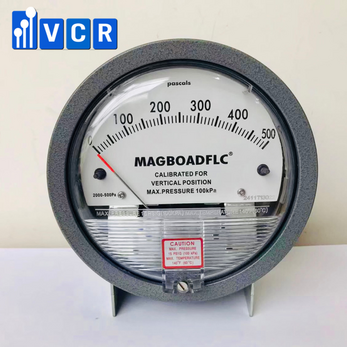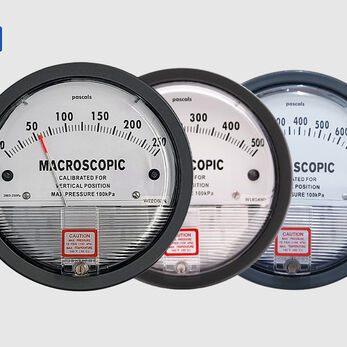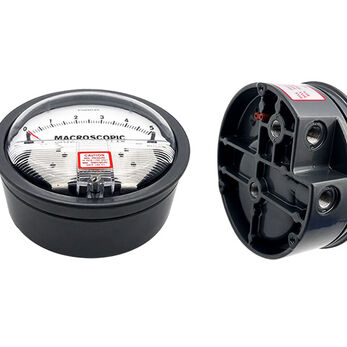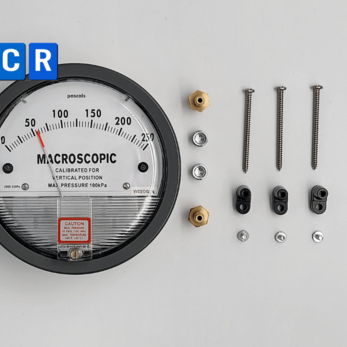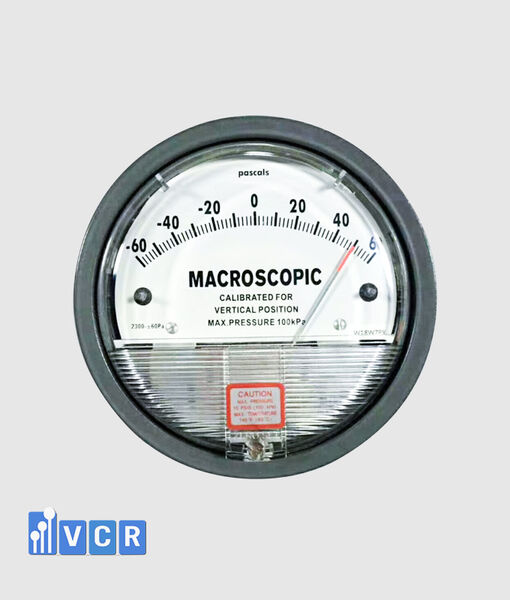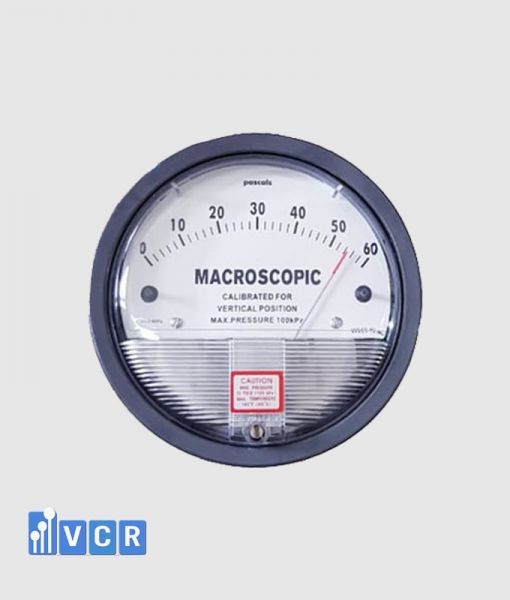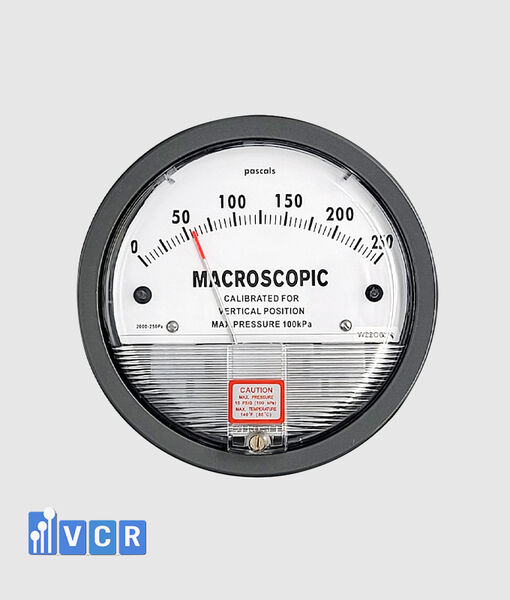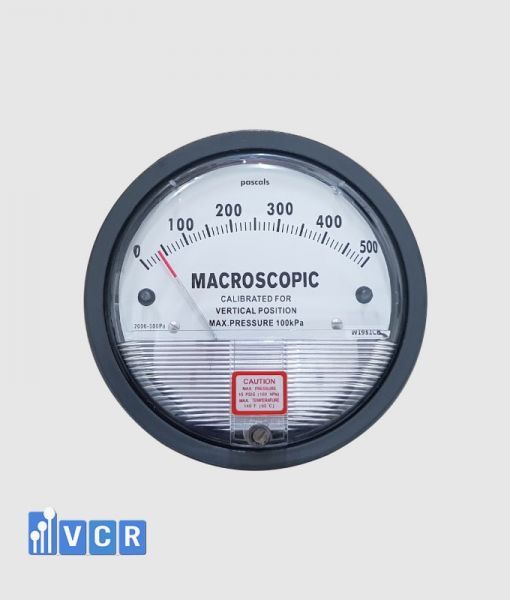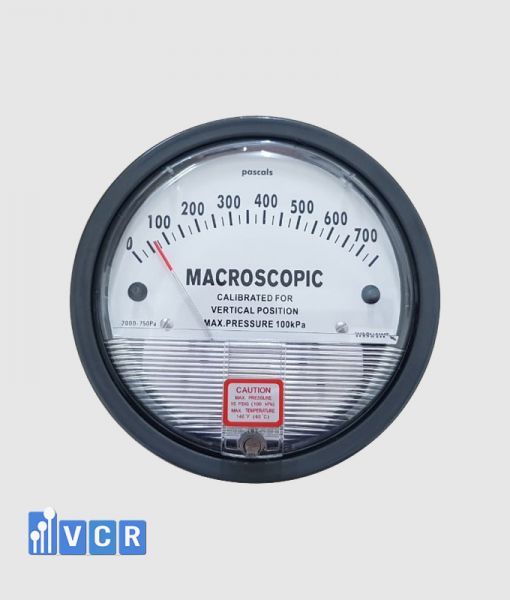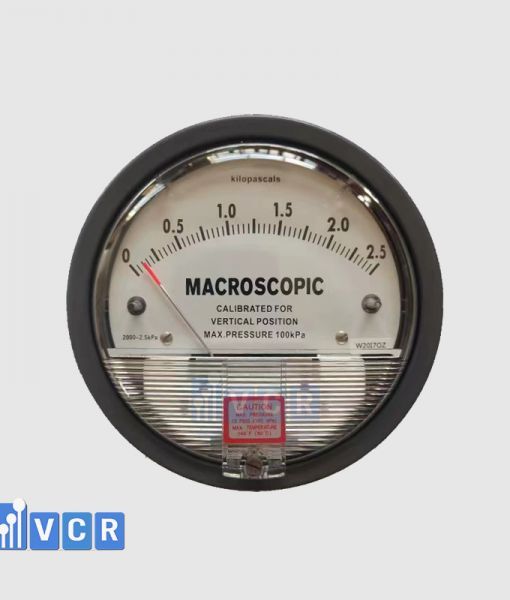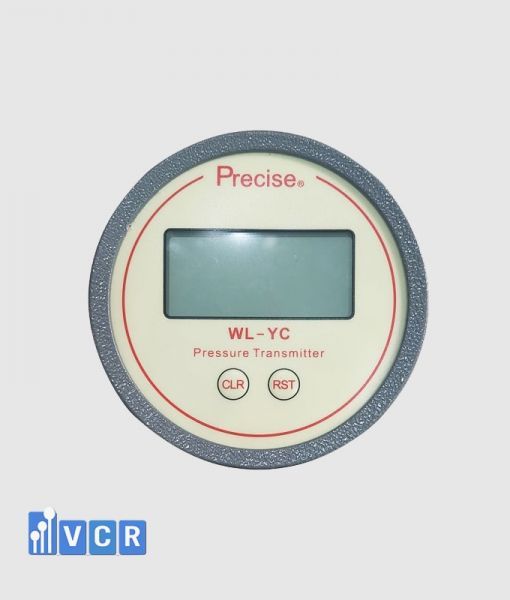

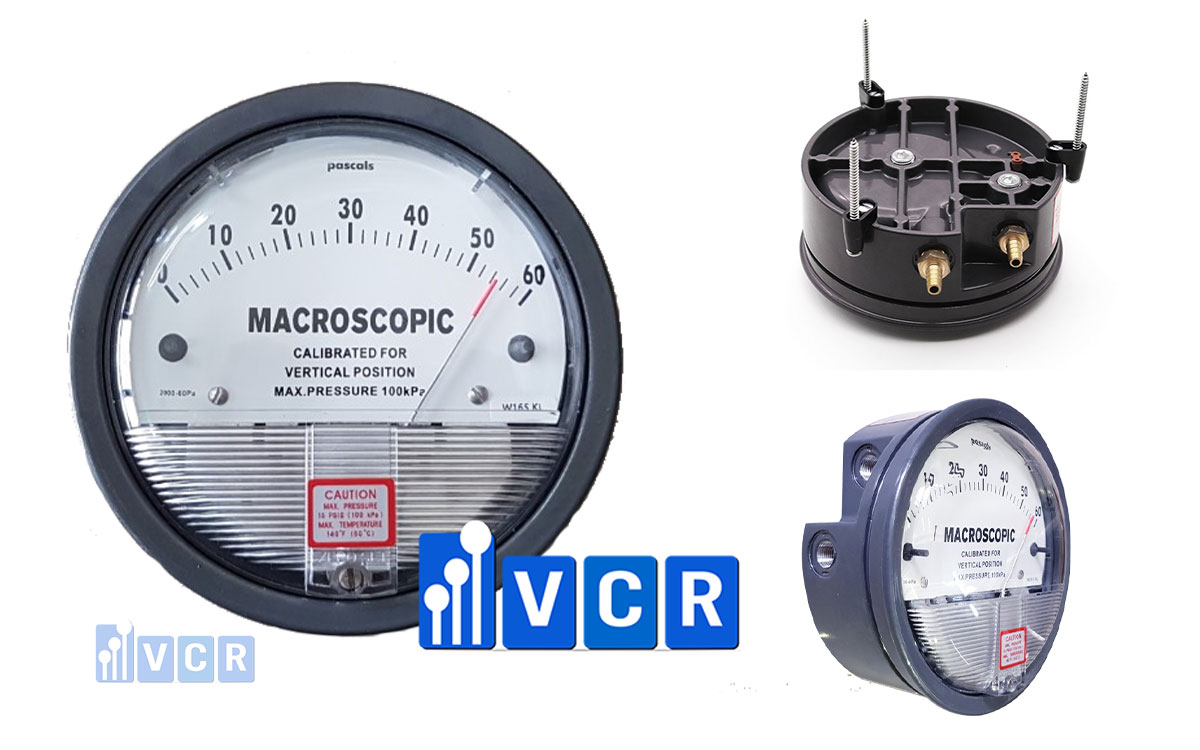
A differential pressure gauge helps maintain airflow direction and segregation in an ISO Class 5 cleanroom. It should be selected according to its range, accuracy, monitoring method, alarms, installation and calibration requirements.
- What is ISO Class 5?
- Why is differential pressure important?
- Does ISO 14644 require 10 Pa for ISO Class 5?
- Does ISO Class 5 require unidirectional airflow?
- Identify the correct measuring point
- Select the correct measuring range
- Accuracy and zero stability
- Mechanical gauge or electronic transmitter?
- Output signals and system integration
- Establishing pressure alarms
- Installation in an ISO Class 5 environment
- Pressure-tap and tubing requirements
- Calibration requirements
- Complete 4–20 mA loop verification
- Acceptance and performance testing
- Required documentation
- Common mistakes
- FAQ: ISO Class 5 differential pressure gauges
- ISO Class 5 differential pressure solutions from VCR Cleanroom Equipment
ISO Class 5 cleanrooms are used for processes requiring strict airborne-particle control, including sterile pharmaceutical manufacturing, medical devices, electronics, semiconductors, precision optics, laboratories and contamination-sensitive assembly.
Maintaining this environment requires more than HEPA or ULPA filtration. The HVAC system must also control airflow volume, airflow direction and pressure relationships with adjacent areas.
A differential pressure gauge helps operators confirm segregation between the ISO Class 5 area and its background, identify deterioration in HVAC performance and provide information for operation, maintenance, investigations and cleanroom acceptance.
ISO 14644 does not prescribe one gauge model, one measuring range or one fixed pressure difference for every ISO Class 5 cleanroom. The instrument should be selected according to the room configuration, manufacturing purpose, airflow direction, contamination risk and monitoring plan.
What is ISO Class 5?
ISO Class 5 is an airborne-cleanliness classification defined by ISO 14644-1. The standard classifies cleanrooms and clean zones according to airborne-particle concentration at specified particle sizes rather than according to room pressure, air-change rate or filter type.
A room cannot therefore be confirmed as ISO Class 5 simply because it operates under positive pressure or uses HEPA filtration. Classification must be performed using an airborne-particle counter at defined sampling locations.
Differential pressure is a supporting parameter used to help maintain the controlled condition. It does not replace airborne-particle classification.
ISO Class 5 conditions may be provided by:
-
A complete cleanroom.
-
A local clean zone within a lower-class background.
-
A Clean Booth or Mini-environment.
-
A unidirectional airflow workstation.
-
A RABS or isolator.
-
A protected area over a manufacturing line.
-
An FFU or full-filter ceiling system.
Each arrangement has different airflow and pressure characteristics. The designer must first determine whether the instrument is measuring room pressure, local enclosure pressure or filter pressure loss.
Why is differential pressure important?
Differential pressure helps control the movement of air between an ISO Class 5 area and its surroundings.
In a conventional positive-pressure arrangement, the ISO Class 5 area is maintained at a higher pressure than the lower-cleanliness background. This reduces the likelihood of uncontrolled air entering the critical space.
Where pressure decreases or reverses, air from corridors, changing areas, airlocks or support rooms may enter the clean zone. Depending on the application, that air may carry particles, fibres, microorganisms or chemical contamination.
Some ISO Class 5 installations operate under negative pressure to contain hazardous chemicals, biological agents or highly active materials.
Positive pressure is therefore not universally correct, and negative pressure is not automatically non-compliant. The airflow direction must support the product-protection, personnel-protection and environmental-containment objectives of the process.
Does ISO 14644 require 10 Pa for ISO Class 5?
ISO 14644 does not require every ISO Class 5 cleanroom to maintain a 10 Pa pressure difference.
ISO 14644-1 classifies air cleanliness by particle concentration, while ISO 14644-2 specifies minimum requirements for a monitoring plan based on parameters that measure or affect airborne-particle concentration.
Ten pascals is frequently referenced in certain industry-specific guidance, particularly for pharmaceutical cleanrooms of different grades. It should not automatically be applied to every ISO Class 5 semiconductor, electronics, optical or medical-device facility.
The required pressure difference should be based on:
-
Cleanliness of adjacent spaces.
-
Intended airflow direction.
-
Room leakage.
-
Door gaps and openings.
-
Supply, return and exhaust airflow.
-
Door-opening frequency.
-
Personnel and equipment loads.
-
Product-protection requirements.
-
Containment requirements.
-
Cross-contamination risk.
-
HVAC balancing and qualification results.
Two adjacent ISO Class 5 rooms may still require a pressure relationship to separate different processes. Conversely, an open ISO Class 5 zone may depend mainly on unidirectional airflow rather than a fixed room-pressure value.
Does ISO Class 5 require unidirectional airflow?
ISO 14644-3 provides test methods for both unidirectional-airflow and non-unidirectional-airflow cleanrooms. It also addresses performance testing in as-built, at-rest and operational occupancy states.
Many ISO Class 5 applications use unidirectional airflow because it delivers clean air across the critical zone and removes contamination from the product area.
However, the ISO Class 5 designation alone does not automatically prescribe one airflow velocity, one filter-coverage ratio or one return-air arrangement.
The selected design should be demonstrated through appropriate tests such as:
-
Airborne-particle classification.
-
Airflow-volume or velocity measurement.
-
Airflow-uniformity testing.
-
Airflow visualization.
-
HEPA or ULPA filter-integrity testing.
-
Recovery testing.
-
Differential pressure verification.
A differential pressure gauge confirms the pressure relationship at the measurement point. It does not replace airflow-performance testing within the ISO Class 5 zone.
Identify the correct measuring point
Pressure-monitoring points associated with ISO Class 5 may include:
-
ISO Class 5 versus ISO Class 6 or ISO Class 7.
-
ISO Class 5 versus an airlock.
-
Cleanroom versus corridor.
-
ISO Class 5 Clean Booth versus its background room.
-
Isolator or RABS versus the surrounding environment.
-
Mini-environment versus the production room.
-
Across a HEPA or ULPA filter.
-
Across AHU pre-filters and intermediate filters.
-
On an FFU, LAF, Pass Box or another cleanroom device.
Room pressure and filter differential pressure serve different purposes. Room pressure helps establish airflow direction, whereas filter differential pressure indicates resistance and operating condition.
The same range should not be specified for both duties unless its suitability has been demonstrated.
Select the correct measuring range
The range should match the design operating pressure.
An excessively wide span makes small changes difficult to observe. A range that is too narrow may overrange during door opening or HVAC start-up.
For room-to-room pressure associated with ISO Class 5, ranges such as 0–25 Pa or 0–50 Pa may be considered where they match the design. These are engineering examples, not mandatory ISO 14644 ranges.
A bidirectional range such as ±25 Pa or ±50 Pa may be appropriate where:
-
Both positive and negative pressure must be monitored.
-
Pressure reversal is possible.
-
The room has multiple operating modes.
-
Containment is required.
-
Imbalance in either direction must be detected.
The final range should consider the target value, alert level, action limit, door-opening transients and possible overpressure.
The normal operating point should fall within a clearly readable portion of the span while retaining adequate capacity for abnormal conditions.
Accuracy and zero stability
ISO 14644 does not prescribe one accuracy class for every ISO Class 5 differential pressure gauge.
Accuracy should be selected according to the separation between the normal operating value, alert level and action limit.
For example, where a room normally operates at 15 Pa and has a 10 Pa action limit, the combined error of the sensor, signal transmission and display system must be small enough to distinguish reliably between the two conditions.
Instrument assessment should include:
-
Accuracy within the working range.
-
Repeatability.
-
Zero drift.
-
Long-term stability.
-
Temperature and humidity effects.
-
Overpressure resistance.
-
Display resolution.
-
Calibration uncertainty.
-
Zero-adjustment method.
Zero stability is particularly important for low-range sensors. A shift of only a few pascals can represent a significant proportion of the actual room pressure.
A resolution of 0.1 Pa or 1 Pa may be considered depending on the span. Additional display digits do not necessarily mean better measurement accuracy.
Mechanical gauge or electronic transmitter?
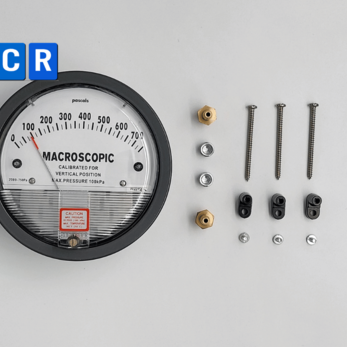
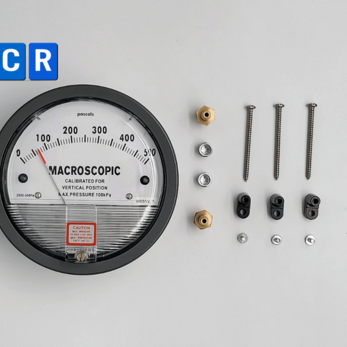
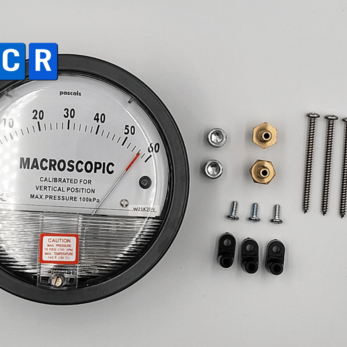
A mechanical differential pressure gauge may be appropriate for local indication or periodic manual recording.
It is simple, requires no electrical power and provides an immediate visual indication.
However, a basic mechanical gauge normally cannot:
-
Record data automatically.
-
Generate a remote alarm.
-
Communicate with a BMS or EMS.
-
Store event time stamps.
-
Display pressure trends.
-
Detect signal loss.
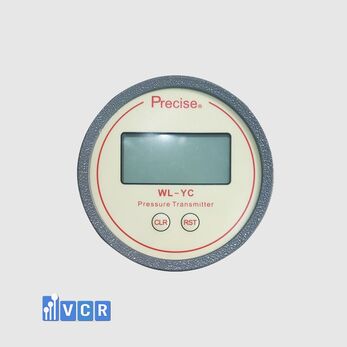
An electronic transmitter or digital differential pressure gauge is generally more suitable for a point that directly affects control of an ISO Class 5 area. It may provide a local display, output signal, alarm relay and central-system communication.
ISO 14644-2 requires a monitoring plan based on parameters that measure or affect airborne-particle concentration. Continuous or periodic pressure monitoring should therefore be determined through risk assessment and the monitoring plan rather than by the ISO Class 5 name alone.
Output signals and system integration
Common output options include:
-
4–20 mA.
-
0–10 V.
-
Modbus RTU.
-
Modbus TCP.
-
BACnet.
-
Alarm relays.
-
Ethernet communication where available.
A 4–20 mA output is widely used because it is suitable for practical transmission distances and can be integrated with a PLC, BMS, EMS or SCADA system.
Where the BMS or EMS value is used to determine cleanroom status, the complete loop should be verified from applied pressure through to the displayed and stored value.
The monitoring system should also identify:
-
Sensor power loss.
-
Open signal wiring.
-
Out-of-range signals.
-
Frozen values.
-
Communication failure.
-
Sensor or zero-adjustment faults.
A failed transmitter should not create a false normal condition.
Establishing pressure alarms
Alarm limits should not be copied from another room or automatically set at 10 Pa.
A suitable alarm strategy normally includes:
-
Target operating value.
-
Normal operating range.
-
Alert level.
-
Action limit.
-
Alarm delay.
-
Reset hysteresis.
-
Defined operator response.
Where a room normally operates at 15 Pa and has a 10 Pa action limit, the alert level may need to be above 10 Pa so deterioration is identified before control is lost.
Alarm delay can prevent nuisance events caused by brief door openings. An excessive delay may conceal an actual loss of segregation.
Alarm settings should be established after HVAC balancing and review of operating data. Alarm functions should be challenged by creating an unacceptable pressure condition or simulating the corresponding signal rather than merely changing a software setpoint.
Installation in an ISO Class 5 environment
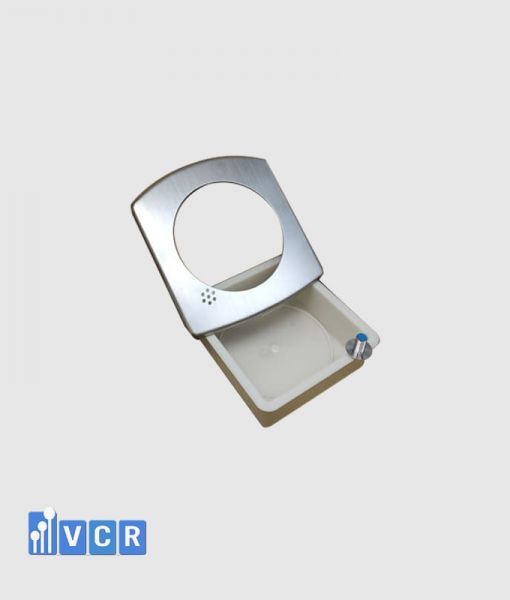
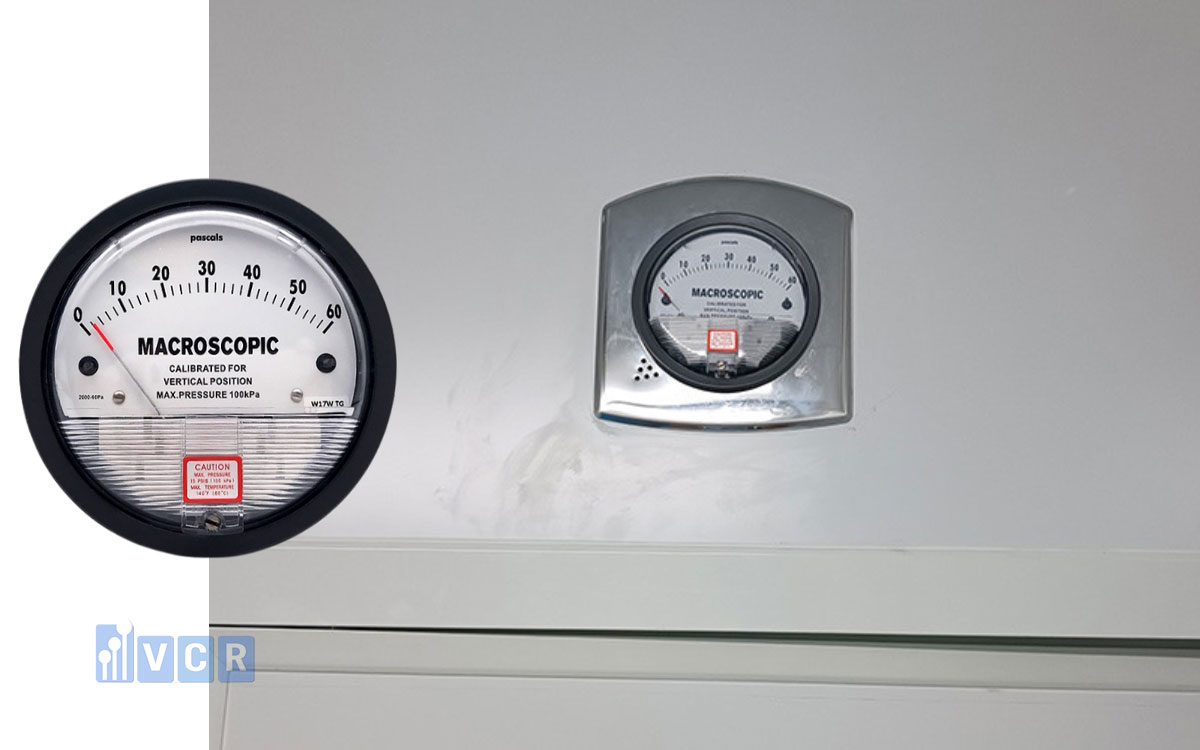
An instrument installed in an ISO Class 5 cleanroom should minimize particle accumulation and allow effective cleaning.
The front face should preferably be flush or nearly flush with the wall panel. Gaps should be sealed using materials compatible with the cleanroom surface and cleaning programme.
The housing, display and seals should withstand the chemicals used in the area.
For electronics and semiconductor facilities, additional considerations may include:
-
Chemical emissions.
-
Particle-shedding materials.
-
Electrostatic-discharge requirements.
-
Airborne molecular contamination.
-
Magnetic properties of materials.
-
Chemical resistance of exposed surfaces.
ISO 14644-4 addresses the cleanroom lifecycle from requirements and design through construction, start-up and verification. Instrument location and acceptance criteria should therefore be defined before procurement and installation.
Pressure-tap and tubing requirements
Pressure taps should measure representative static pressure.
They should not be installed:
-
Directly in a supply-air jet.
-
In a high-velocity airflow region.
-
Too close to a return-air grille.
-
Directly at a door gap.
-
Close to a fan or pressure disturbance.
-
Where liquid may accumulate.
-
Where the port may be obstructed or damaged.
The high- and low-pressure ports must be connected correctly. Reversed connections will produce an incorrect sign or airflow direction.
Tubing should be leak-tight and protected against kinking, crushing and liquid accumulation. The two lines should be clearly identified to prevent incorrect reconnection during maintenance.
Where a reference port is installed in a wall cavity or technical ceiling, the designer should verify that this space truly represents the intended reference pressure.
Calibration requirements
The instrument should be calibrated before use and at approved intervals.
Calibration should not be limited to zero. Test points should cover:
-
The normal operating range.
-
Alert level.
-
Action limit.
-
The upper portion of the working span where relevant.
The reference instrument should have suitable accuracy and metrological traceability.
The calibration certificate should show individual test-point results, measurement error, acceptance criteria and calibration uncertainty where applicable.
Calibration frequency should reflect instrument criticality, manufacturer recommendations, environmental conditions and historical drift.
Where the instrument is found out of tolerance, the facility should assess the effect on previous pressure data and on the ISO Class 5 condition during the affected period.
Complete 4–20 mA loop verification
Where the official value is read from a BMS or EMS, the transmitter calibration certificate alone is not sufficient.
Loop testing should verify:
-
Reference pressure.
-
Local transmitter display.
-
Output current.
-
PLC analogue-input value.
-
HMI, BMS or EMS indication.
-
Relay operation.
-
Alarm status.
-
Historical data record.
Error may originate in the sensor, signal converter, wiring, analogue-input module, software or scaling configuration.
Acceptance and performance testing
ISO 14644-3 provides test methods for cleanrooms in as-built, at-rest and operational states. The required occupancy state should be specified in the URS, design documents or acceptance plan.
Differential pressure acceptance testing should consider:
-
Stable HVAC operation.
-
Door opening and closing.
-
Pressure recovery time.
-
Personnel and equipment effects.
-
Fan failure or reduced airflow.
-
Sensor-signal loss.
-
Power failure and restoration.
-
Alarm operation.
-
Agreement between local and central values.
ISO 14644-5:2025 includes maintenance and monitoring within the operational-control programme. The differential pressure gauge should therefore remain under control throughout its operating lifecycle rather than being assessed only during initial handover.
Required documentation
The instrument documentation package should include:
-
User Requirement Specification.
-
Technical datasheet.
-
Model, serial number and measuring range.
-
Installation-location drawing.
-
High- and low-pressure connection diagram.
-
Electrical wiring diagram.
-
Calibration certificate.
-
On-site test results.
-
Signal-loop test record.
-
Alarm-challenge record.
-
Operating and maintenance instructions.
-
Inspection and calibration procedure.
-
Maintenance history.
-
Alarm-setpoint change records.
-
Impact assessment following an out-of-tolerance result.
Common mistakes
Common errors include:
-
Assuming ISO Class 5 always requires 10 Pa.
-
Selecting an excessively wide range.
-
Using one range for room and HEPA-filter pressure.
-
Reviewing only full-scale accuracy.
-
Ignoring zero drift.
-
Positioning the pressure tap beside a supply-air diffuser.
-
Reversing the high- and low-pressure ports.
-
Failing to check tubing leakage.
-
Calibrating the transmitter without checking the loop.
-
Failing to challenge alarms under operating conditions.
-
Failing to determine recovery after door opening.
-
Assuming differential pressure can replace particle classification.
FAQ: ISO Class 5 differential pressure gauges
Must an ISO Class 5 room maintain 10 Pa?
No. ISO 14644 does not specify one universal pressure difference for every ISO Class 5 room. The required value should be based on airflow direction, background cleanliness, HVAC configuration, manufacturing application and risk assessment.
Does ISO Class 5 require continuous pressure monitoring?
The ISO class alone does not determine the monitoring frequency. The monitoring plan should define whether continuous or periodic measurement is appropriate according to the effect of pressure on cleanroom performance. Critical points are generally suitable for continuous monitoring and alarms.
Can a mechanical gauge be used?
Yes, for local observation or periodic manual recording. A point directly affecting control of the ISO Class 5 area should normally use an electronic transmitter with alarms and data output.
Does a pressure gauge prove that the room meets ISO Class 5?
No. ISO Class 5 is determined by airborne-particle concentration testing under ISO 14644-1. Differential pressure is a supporting parameter used to maintain control.
Can a room-pressure gauge measure HEPA-filter pressure?
Only where its range, accuracy and overpressure capability are suitable. Filter pressure loss is normally higher than room-to-room pressure and usually requires a separate measuring range.
ISO Class 5 differential pressure solutions from VCR Cleanroom Equipment
VCR Cleanroom Equipment supplies and supports the selection of differential pressure gauges, transmitters and monitoring solutions for ISO Class 5 cleanrooms, Clean Booths, Mini-environments, LAF units, FFUs, Pass Boxes, Air Showers, Dispensing Booths, HEPA Boxes and HVAC systems.
VCR can assist with defining the measurement purpose, range, accuracy, 4–20 mA output, Modbus communication, alarm functions, calibration requirements and acceptance documentation for each project.
Hotline: 090.123.9008
Email: [email protected]
Website: https://vietnamcleanroom.com